


Will You Go Where God Leads You?
The Road Is Not Always Pleasant, But It Is the Right Road
There is a great temptation while living our everyday lives to choose the easy road, and avoid the difficulties we might encounter while negotiating a narrow, steep pathway. Our human nature tells us to live a life of ease and retirement … not that we should seek out pain and suffering, for such afflictions will surely come no matter how hard we might try to avoid them. In fact, it seems that God insures us the degree of suffering we need at the proper times to nudge us toward whatever changes we need, for without the inclusion of suffering and pain we would likely not make those changes. Peter calls these afflictions “precious”:
 “That the trial of your faith, being much more precious than gold that perishes, though it be tried with fire, might be found unto praise and honor and glory at the appearing of Jesus Christ ….” (I Peter 1:7, KJV).
“The spirit itself bears witness with our spirit that we are the children of God; and if children, then heirs, heirs of God, and joint hears with Christ, if so be that we suffer with Him, that we may also be glorified together” (Romans 8:16-17).
Where Is God Leading?
Given the essentiality of sufferings and trials, for which James says we should rejoice in James 1:2, how are we to understand why we are being led in a certain direction? Why is a specific difficulty being encountered that more-or-less forces us to move in a certain direction, if not to move to another location then at least to make specific changes in our character and habits? May we conclude in a major way that we are not likely to perceive the reasons for the trials, just as Solomon made clear:
“… a man cannot find out the work that is done under the sun, because though a man labor to seek it out, yet he shall not find it; yea further, though a wise man think to know it, yet shall he not be able to find it” (Ecclesiastes 8:17, KJV).
We just know that the direction we are being led is for good because of the incredible love God has for us, whose plan of the eons destines each of us for eternal responsibilities and rewards beyond anything we can imagine.
“For since the beginning of the world men have not heard, nor perceived by the ear, neither has the eye seen, O God, beside You, what He has prepared for him that waits on Him” (Isaiah 64:4; see also I Corinthians 2:9).
“And we know that all things work together for good to them that love God, to them who are the called according to His purpose” Romans 8:28).
“But rather seek you the kingdom of God, and all these things shall be added unto you. Fear not, little flock, for it is your Father’s good pleasure to give you the kingdom” (Luke 12:31-32).
“Let not your heart be troubled: you believe in God, believe also in Me. In my Father’s house are many mansions (Strong 3438, mone, ‘an abode’); if it were not so I would have told you. I go to prepare a place for you. And if I go and prepare a place for you, I will come again and receive you unto Myself, that where I am you may be also” (John 14:1-3).
The Example of the Patriarchs and Prophets
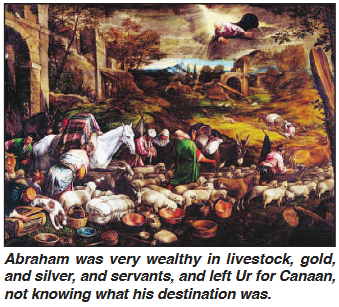
Let us examine the lives of fellow-saints that have lived before us and view their willingness to go where God led them. Look at the person Abraham, a man lauded by our Creator as being the “father of the faithful” for his obedience to God’s calling to leave the land of his nativity and travel to a new land where he was directed.
Abraham
“By faith Abraham, when he was called to go out into a place which he should after receive for an inheritance, obeyed, and he went out, not knowing where he went. By faith he sojourned in the land of promise, as in a strange country, dwelling in tabernacles with Isaac and Jacob, the heirs with him of the same promise. For he looked for a city which has foundations, whose Builder and Maker is God” (Hebrews 11:8-10).
Notice that Abraham left Ur of the Chaldees for Canaan without questioning the wisdom of God — yet he left with a great promise on ahead that he truly believed would come. He did not leave blindly, but knew in his heart of hearts that the promises on ahead were true and were worth every bit of sacrifice he would expend to fulfill them. (Is the situation any different with us?) Look at what Abraham (first named Abram) was promised:
“Now the Lord had said to Abram: ‘Get out of your country, from your family and from your father’s house, to a land that I will show you. I will make you a great nation; I will bless you and make your name great; and you shall be a blessing. I will bless those who bless you, and I will curse him who curses you; and in you all the families of the earth shall be blessed.’ So Abram departed as the Lord had spoken to him, and Lot went with him. And Abram was seventy-five years old when he departed from Haran” (Genesis 12:1-4).
 “After these things the word of the Lord came to Abram in a vision, saying, ‘Do not be afraid, Abram. I am your shield, and your exceeding great reward.’ But Abram said, ‘Lord God, what will You give me, seeing I go childless, and the heir of my house is Eliezer of Damascus?’ Then Abram said, ‘Look, You have given me no offspring; indeed one born in my house is my heir!’ And behold, the word of the Lord came to him, saying, ‘This one shall not be your heir, but one who will come from your own body shall be your heir.’ Then He brought him outside and said, ‘Look now toward heaven, and count the stars if you are able to number them.’ And He said to him, ‘So shall your descendants be.’ And he believed in the Lord, and He accounted it to him for righteousness. Then He said to him, ‘I am the Lord, who brought you out of Ur of the Chaldeans, to give you this land to inherit it’” (Genesis 15:1-7).
“When Abram was ninety-nine years old, the Lord appeared to Abram and said to him, ‘I am Almighty God; walk before Me and be blameless. And I will make My covenant between Me and You, and will multiply you exceedingly.’ Then Abram fell on his face, and God talked with him, saying: ‘As for Me, behold, My covenant is with you and you shall be a father of many nations. No longer shall your name be called Abram, but your name shall be Abraham: for I have made you a father of many nations. I will make you exceedingly fruitful; and I will make nations of you, and kings shall come from you And I will establish My covenant between Me and you and your descendants after you in their generations, for an everlasting covenant, to be God to you and your descendants after you. Also I give to you and your descendants after you the land in which you are a stranger, all the land of Canaan, as an everlasting possession; and I will be their God’” (Genesis 17:1-8).
 The promises to Abram were incredibly great: all the land of Canaan, descendents numbering as many as the stars of heaven, mighty nations and kings to come from him — amazing promises when as yet Isaac, the child through whom all of these things would be fulfilled, had not yet even been born! Not only that, but they were given after the age of childbearing had long passed! Abraham believed these promises, so one can understand that such wonderful faith in the Creator’s ability to carry through His promises would be counted as righteousness. The command to leave home and move to a strange land was coupled with the promise of great wealth and family blessings on ahead. It is the same command that God’s people have today:
“And I heard another voice from heaven, saying, ‘Come out of her [Babylon], My people, that you be not partakers of her sins, and that you receive not of her plagues. For her sins have reached unto heaven, and God has numbered her iniquities.’” (Revelation 18:4-5).
Jeremiah
The promises Yahweh set before Jeremiah were quite incredible, rewards that the Eternal had set before him even before his conception! Notice what was said of him in Jeremiah 1:4-10:
“Then the word of the Lord came to me, saying: ‘Before I formed you in the womb I knew you; before you were born I sanctified you; I ordained you a prophet to the nations.’ ‘Ah, Lord God! Behold, I cannot speak, for I am a youth.’ But the Lord said to me: ‘Do not say I am a youth. For you shall go to all to whom I send you, and whatever I command you, you shall speak. Do not be afraid of their faces, for I am with you to deliver you.’ says the Lord. Then the Lord put forth His hand and touched my mouth, and the Lord said to me: ‘Behold, I have put My words in your mouth. See, I have this day set you over the nations and over the kingdoms, to root out and to pull down, to destroy and to throw down, To build and to plant’” (Jeremiah 1:4-10).
Jeremiah was “set over nations and kingdoms,” with the authority “to root out and to pull down, to destroy and to throw down, to build and to plant.” Those responsibilities as a prophet were fraught with great suffering, rejection, and harassment, but Jeremiah did not hold back. He fulfilled the commission he was sent to fulfill despite the pain he knew he would experience. Those trials were experienced by all of God’s prophets to one degree or another.
Isaiah
Like Jeremiah, the Eternal called Isaiah from before his birth (Isaiah 49:1, 5) to be a prophet to Israel. He was born with a designed purpose:
“And He has made My mouth like a sharp sword; in the shadow of His hand He has hidden Me, and made Me a polished shaft; in His quiver He has hidden Me …. And now the Lord says, who formed Me from the womb to be His Servant, to bring Jacob back to Him, so that Israel is gathered to Him (for I shall be glorious in the eyes of the Lord, and My God shall be My strength)….”
The translators of these verses claim that the person being spoken of here is Jesus Christ — and that may be so — but the primary reference here is to Isaiah himself, who was given a mouth to speak fiery rebukes against the sins of the nation, to warn them of impending doom if they refused to repent of their evil ways.
Isaiah was given an awesome calling through seraphim [saraph, “burning, a saraph, copper in color”], one of which touched his mouth with a live coal from the altar. That procedure took away his iniquity and purged his sins (Isaiah 6:7). The Lord Himself spoke from His throne nearby, saying “Whom shall I send, and who will go for Us?” Then Isaiah responded, “Here am I! Send me” (Isaiah 6:8). He was willing to take on the awesome responsibility of a prophet in spite of his acknowledgment of being “a man of unclean [tame, ‘defiled, polluted’] lips” (Isaiah 6:5).
Amos
This humble sheep herdsman and farmer from Tekoa could hardly be classified amongst the noble gentry of Israel. Yet he was chosen to prophesy to the king and “official” prophets of the nation the harsh but truthful words of the Eternal, which were anything but pleasant in the ears of Amaziah, the priest of Bethel. Amos preached that King Jeroboam would die by the sword and Israel would be taken captive to a foreign land (Amos 7:11)Amos told Amaziah, in the face of likely great personal retribution:
“Then Amos answered, and said to Amaziah: ‘I was no prophet, nor was I a son of a prophet, but I was a sheepbreeder and a tender of sycamore fruit. Then the Lord took me as I followed the flock, and the Lord said to me, “Go, prophesy to My people Israel.” Now therefore , hear the word of the Lord: “You say, Do not prophesy against Israel, and do not spout against the house of Isaac. Therefore thus says the Lord: Your wife shall be a harlot in the city; your sons and daughters shall fall by the sword; your land shall be divided by survey line; you shall die in a defiled land; and Israel shall surely be led away captive from his own land”’” (Amos 7:14-17).
In spite of the threats leveled against him, Amos did not back down from the mission the Eternal had commissioned for him. He was not afraid.
Peter
Peter the fisherman was called to a critical and unforgiving task as an apostle of Jesus Christ. A brash and impetuous person — “Lord, not my feet only, but also my hands and my head!” (John 13:9) — he faced the Savior after the crucifixion and resurrection at the Sea of Galilee. Fishing all night with six other disciples, no fish were caught, but Jesus from the shore shouted, “Cast the net on the right side of the boat, and you will find some” (John 21:6). Find some they did, 153 of them, but yet the net did not break despite the load.
Jesus called the disciples to eat breakfast with Him, and after eating He spoke to Peter: “Simon,son of Jonah, do you love Me more than these?”
Peter answered, “Yes, Lord; You know that I love You,” upon which Jesus replied, “Feed My lambs.”
A second time Jesus asked Peter, “Simon, son of Jonah, do you love Me?,” to which Peter answered, “Yes, Lord, You know that I love You.” Jesus answered, “Tend My sheep” (John 21:16-17).
A thrid time Jesus implored Peter, “Simon, son of Jonah, do you love Me?,” to which a grieved Peter replied,”Lord, You know all things; You know that I love You.” Jesus’ reply was, “Feed My sheep” (John 21:17).
Following this trying exchange that Peter experienced with Jesus, He laid out to him — and to all of the disciples — the pathway for their witnessing the truth for the rest of their lives:
“Most assuredly, I say to you, when you were younger, you girded yourself and walked where you wished, but when you are old, you will stretch out your hands, and another will gird you and carry you where you do not wish” (John 21:18).
Jesus then said to him, “Follow Me.” That simple two-word command sealed the entire future for Peter ,and for all of the disciples who certainly heard these words. This prophecy to Peter even alluded to the horrible death he would experience, which history reveals was being crucified upside down.
The Apostles
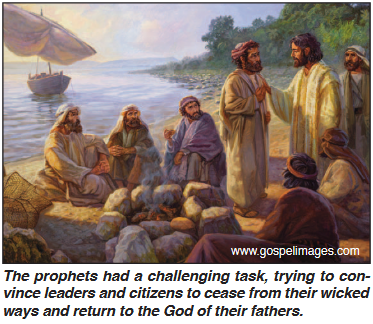 The title apostle comes from the Greek apostoles, meaning “one sent forth.” All of the apostles “went forth” to accomplish what God commanded them to do, as attested to by many Scriptures. Notice in Luke 6:13 that one day He called the disciples to Himself, and from them He chose 12 men whom He also named apostles. From the beginning of their calling to be Christ’s apostles — those sent forth — they did not shy away from that calling, except for Judas Iscariot. That commission was stated in Matthew 28:19-20:
“Go therefore and make disciples of all nations, baptizing them in the name of the Father and of the Son and of the holy spirit, teaching them to observe all things that I have commanded you; and lo, I am with you always, even to the end of the age.”
The disciples accomplished that very commission, making disciples in nations throughout the civilized world, and baptizing them as commanded by Jesus. They went where God led them in spite of death threats that would have stopped most people. These amazing men filled with the holy spirit did not fear what men might do to them, but true to the word of God exemplified the Eternal’s character:
“There is no fear in love, but perfect love casts out fear …” (I John 4:18).
“The fear of man brings a snare, but whoever trusts in the Lord shall be safe” (Proverbs 29:25).
We must not forget the other apostles besides the 12, and Paul, who are mentioned in Scripture. These individuals were also sent forth to go where the Eternal would lead them. Andronicus and Junia were two of them that Paul mentions in Romans 16:7, but there were others not mentioned here. Titus was a “messenger of the churches,” and Paul implies in II Corinthians 8:23-24 that there were others “sent forth,” such as Epaphroditus (Philippians 2:25). One may ask the question, where does the demarcation between being a member of the body of Christ and being an apostle begin? In a real sense all of God’s people are sent forth into the world, as “sojourners and pilgrims” (I Peter 2:11) who are now fellow citizens with the saints and members of the household of God (Ephesians 2:19).
Paul
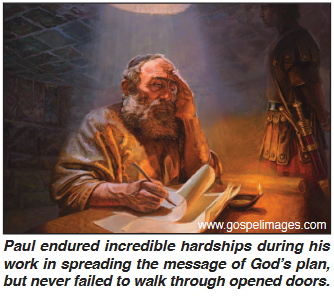 The apostle Paul is an amazing example of one who went where the Eternal led him, through incredible trials that would have turned away anyone who did not possess a vivid vision of the future: the kingdom of God. His trials included many imprisonments, lashes with a whip, beatings with rods, stoning, being shipwrecked, robbed, and fraught with weariness and toil, perils of false brethren, hunger, thirst, cold, and other challenges (II Corinthians 11:23-28). Yet, he never wavered from the calling that Jesus spoke to him on the road of Damascus: “Saul, Saul, why are you persecuting Me?…. Arise and go into the city, and you will be told what you must do” (Acts 9:4, 6).
After some days among the disciples in Damascus, having received his sight by Ananias laying his hands on him, “Immediately he preached the Christ in the synagogues, that He is the son of God” (Acts 9:17-20).
Paul was “one sent forth,” “called out of time” after the original 12, a disciple who never wavered in his loyalty to his calling to the commission to go unto the gentiles (Acts18:6). His dogged dedication to his duty never failed.
Jesus Christ
I bring up Jesus Christ in this discussion as well, since He was (is) not just the Son of God, but the most expansive and definitive example of an apostle, disciple, and every other description one can place upon an individual … for He is the son of God and Creator of what we see around us.
Indeed, His example of interacting with His heavenly Father epitomizes how we should go wherever the Father leads us. He especially made plain His doing whatever the Father directed Him to do:
“Then Jesus answered and said to them, ‘Most assurely, I say to you, the Son can do nothing of Himself, but what he sees the Father do; for whatever He does, the Son also does in like manner’” (John 5:19).
“I can of Myself do nothing. As I hear, I judge; and My judgment is righteous, because I do not seek My own will but the will of the Father who sent Me” (John 5:30).
“For I have come down from heaven, not to do My own will, but the will of Him who sent Me” (John 6:38).
“Jesus said to them, ‘My food is to do the will of Him who sent Me, and to finish His work’” (John 4:34).
Jesus did precisely what His Father directed Him to do, as an obedient son would do for a loving father. He did so in spite of the horrible scourgings and false accusations He endured before His crucifixion … all in order to pay the price for our sins — the perfect, sinless sacrifice for us unworthy souls! His life is a stellar example for each of us to follow, even as we are admonished in I Peter 2:21, “… because Christ also suffered for us, leaving us an example, that you should follow His steps.” He is the epitome of the fulfillment of His own prophetic utterance when He stated:
“Assuredly I say to you, there is no one who has left house or brothers or sisters or father or mother or wife or children or lands, for My sake and the gospel’s, who shall not receive a hundredfold now in this time — houses and brothers and sisters and mothers and children and lands, with persecutions — and in the age to come eternal life” (Mark 10:29-30).
Jesus never participated in the world’s corrupt, Satan-inspired government and lawlessness and has become the Inheritor and King over all the earth — King of Kings and Lord of Lords (Revelation 19:16) — even as the saints who follow in His footsteps will join Him on His throne in the Father’s heavenly city (Revelation 3:21), and reign on the earth with Him for 1,000 years (Revelation 20:4).
Allow me to add a few personal experiences to this list as well. Since my wife and I were called and baptized into God’s ecclesia in 1971, we have had to face innumerable tests these past 55 years. These tests involved acquiring higher education in soil and crop sciences at secular universities, then returning to the home farm in Minnesota to begin a life on the land I had imagined would last the rest of my family’s life; it was the fulfillment of a lifelong dream. The Eternal had other plans. Conflict with my father over Sabbath and Holy Day observance, plus economic realities in the agricultural sector — corn sold for only $0.85/bushel after drying costs, despite excellent crop yields — and unwillingness of the family to help us, forced our impoverished family to leave fathers, mothers, family members, and the land we loved for education at a religious college in Texas. The door was opened to escape the poverty of the Northern Plains, and we stepped through it … like Abraham did, not really knowing where we were going.
After a brief two-year stint there, a door was opened to pursue farming once again, this time as a farm manager in Wisconsin. That dream closed after three years, and a door to achieving a Ph.D. in soils opened at North Dakota State University. Once again we followed God’s lead, and for four years I labored to achieve that degree, not knowing where it might lead.
A door opened with a firm in Texas, so we journied to the east Texas piney woods, where I consulted with soils and crops for an enterprise that brought me to many nations and before government and corporate officials — to Australia, China, Russia, Indonesia, South Africa, Zimbabwe, Egypt, Jordan, Syria, Spain, Chile, Ecuador, and other nations. Avenues of service to farmers were opened on many fronts, enabling messages of better ways of farming to be spread far beyond the confines of an Upper Midwest farm where I had envisioned I would spend the rest of my life. The Eternal had a plan far better than I could have ever imagined. Though not knowing where I was being led, God’s hand opened doors continuously; I only had to walk through them — and so it is to this very day.
Follow Our Calling to the End!
Will you go where God leads you? Abraham did not fear leaving the comforts and conveniences of his native Ur of the Chaldees, forsaking family and friends, familiar towns and farmlands, for the sake of a calling far beyond his comprehension. He went where the Eternal told him to go, “… not knowing where he was going” (Hebrews 11:8). The prophets and apostles were placed before harsh and antagonistic rulers and magistrates, preaching highly unpopular messages of repentance to stiff-necked, hard-hearted countrymen. Jesus Christ rejected all temptations to partake of Satan’s world system and combatted his deception in the wilderness, confronted the established religious leaders of His day, and endured through incredible pain and hardships at the end in order to prepare a place for us in the Kingdom.
Are we willing to follow in Christ’s and His servants’ footsteps to the very end of our lives? After all, we read, “But he that endures to the end shall be saved” (Matthew 24:13, see also Matthew 10:22). Can we endure being hated of all nations for Christ’s names’s sake, be willing to have friends betray us, avoid the messages of false prophets, stand fearlessly before judges who will question our allegiance to the coming King of all the earth, and refuse to bow down to earthly kings or deny the love we must have for one another?
Will you go wherever God leads you? Do you have the faith to believe to your inner core that He will guide you safely along the course of life, even if it means great trouble and pain, as the apostle Paul experienced after his calling, and as the prophets experienced while they were sent to admonish the Israelites to repent of their evil ways? So many of them were killed when they exposed their countrymen’s sins (Luke 13:34; Romans 11:3; etc.). In fact, any of us may be killed in the process of witnessing for the truth and preaching in Jesus’ name (Matthew 24:9; Luke 21:16; Revelation 13:15).
Like Jesus Christ, we must be willing to follow wherever our heavenly Father leads us. It is our calling, our commitment as long as we have breath, for we all will die at some time, either from disease, accident, old age, or at the hands of other men. For us, the elect, the next moment of consciousness will be eternal spirit life at the resurrection. That reward is beyond our comprehension in its joy and magnificence, but is worth very ounce of effort we can muster, through God’s indwelling spirit, to endure to the end!
“For I consider that the sufferings of this present time are not worthy to be compared with the glory which shall be revealed in us” (Romans 8:18)!