


Why a Perfect God Lets You Suffer
How Can Our Loving Heavenly Father Allow Us to Suffer Through Pain and Hardship?
It is easy and tempting for us to suggest that a perfect and just God should not allow suffering in the world, for either the elect or for those in the world — for we are all made in His image, and He loves us all dearly. However, reality tells us that there is immense suffering in this world. Not one person is immune to some degree of it.
This being the case, then there must be reasons for this trouble we call suffering. The term suffering — not to be confused with the use of the word suffer to mean “to give” (didomi), “to send away” (aphiemi), “forfeiting what is of greatest value” (zamioo), or certain other meanings of suffer — is translated from the Greek pascho, meaning “to experience a sensation or impression, usually painful.” This pain can be of physical or psychological origin, and expresses itself within life in many ways. Mankind is created full of pain sensors throughout the body, nerve endings that communicate to our consciousness the need to avoid the causative stimulus. Oftentimes the body’s reaction is automatic through our autonomic nervous system, which will cause one’s hand to instantly pull away from touching a hot stove. We strive to avoid pain and suffering when we can; sometimes we cannot. This is especially true with emotional pain linked to conflicts with other people, whose lack of love and selfless support erode the joy and peace of interacting with another person.
The garden of Eden before Adam and Eve sinned was a place filled with the character of God’s spirit: love, joy, peace, longsuffering, kindness, goodness, faithfulness, gentleness, and self-control (Galatians 5:22-23). There was no suffering — physical or emotional pain: “And out of the ground the Lord God made every tree grow that is pleasant to the sight and good for food” (Genesis 2:9). This was the perfect environment the Creator designed for the people made in His very image. The word Eden comes from eden, meaning “pleasure,” which word is taken from the Greek edan, meaning “to be soft and pleasant, to live voluptuously.” Pain and suffering were not intended for mankind from the beginning.
Things changed greatly once Adam and Eve sinned. First of all they experienced fear and shame, as evidenced by their hiding themselves from Yahweh Elohim (Genesis 3:8). Eve was prophesied to experience great sorrow, and bring forth children with much pain (Genesis 3:16). Adam was told he would experience great hardship in producing food crops, sweating to cultivate crops while having to cope with weeds such as thorns and thistles that would compete as he struggled to raise crops — rather than easily harvest the fruits and herbs from a garden that required only joyful tending. Adam’s life was drastically changed from abundantly producing crops with little effort to a continual odyssey of farming just to survive.
Of course, we know that it was Satan the Devil who tempted Adam and Eve to sin, which resulted in them being forced to leave their luxurious garden for the uncertainties and stresses of the world outside the garden. Thus, pain entered at a momentous juncture of history — pain of body, mind, and spirit, ushering in 6,000 years of war, murder, hunger, disease, and calamity upon the entire face of the earth. Satan the Devil, not a pure and sinless Adam, now took control of the earth’s governments based on his merchandising system (Ezekiel 28:16-18; Revelation 18:1-24). The purity of living was gone, replaced by avarice, greed, pride, self-gratification, jealousy, and hedonism, fruits of the flesh that fought to replace the fruits of God’s spirit in people’s lives (Galatians 5:19-21).
Not only did these evil fruits lead to war and competition among people, these dark deeds have led to pain and suffering up to the present day. Satan is the god of this world.
“Again, the devil took Him up on an exceedingly high mountain, and showed Him all the kingdoms of the world and their glory. And he said to Him, ‘All these things I will give You if you will fall down and worship me’” (Matthew 4:8-9).
“… whose minds the god of this age has blinded, who do no believe, lest the light of the gospel of the glory of Christ, who is the image of God, should shine on them” (II Corinthians 4:4).
Yet, suffering is an intrinsic part of today’s world, and as such it serves a great purpose — for the Eternal allows it. Let us examine Scripture and discover these purposes, for God does nothing without great design.
1. Suffering Helps Develop God’s
Character in Us.
It is the Eternal’s design that we become perfect: “Therefore you shall be perfect [teleios, ‘complete, in various applications of labor, growth, and mental and moral character’], just as your Father in heaven is perfect” (Matthew 5:48). We are to be like our forefather Adam before he sinned, and like Jesus was sinless throughout His life, though he was “… in all points tempted as we are, yet without sin” (Hebrews 4:15). We become those sinless creatures of His once we repent of our sins, and are baptized, have hands laid on us, and receive His spirit through the sacrifice of Jesus Christ for the remission [aphesis, “freedom, pardon”] of our sins (Luke 24:47; Acts 2:38; 10:43; etc.).
“To Him who loved us and washed us from our sins in His own blood, and has made us kings and priests to His God and Father …” (Revelation 1:5-6).
 Our heavenly Father removes our past shortcomings from us as far as the east is from the west (Psalm 103:12). With this spirit of His within us that has given newness of life — a clean slate to begin life anew, as it were — we are admonished to flee our past errors and put on the perfection of Christ and the Father.
“Do not be deceived. Neither fornicators, nor idolaters, nor adulterers, nor homosexuals, nor sodomites, nor thieves, nor covetous, nor drunkards, nor revilers, nor extortioners will inherit the kingdom of God. And such were some of you. But you were washed, but you were sanctified [hagiazo, ‘make holy, purify’; from hagios, ‘sacred, pure, morally blameless’], but you were justified in the name of the Lord Jesus and by the spirit of our God” (I Corinthians 6:9-11).
Suffering and pain drive us toward this perfection which the Eternal requires of us.
“Blessed are those who are persecuted for righteousness’ sake, for theirs is the kingdom of heaven. Blessed are you when they revile and persecute you, and say all kinds of evil against you falsely for My sake … for so they persecuted the prophets who were before you” (Matthew 5:10-12).
“My brethren, take the prophets who spoke in the name of the Lord, as an example of suffering and patience” (James 5:10).
“Therefore, since Christ suffered for us in the flesh, arm yourselves also with the same mind, for he who has suffered in the flesh has ceased from sin, that he no longer should live the rest of his time in the flesh for the lusts of man, but for the will of God” (I Peter 4:1-2).
“Yes, and all who desire to live godly in Christ Jesus will suffer persecution” (II Timothy 3:12).
 Pain, suffering, and persecution drive us away from sinful living, and cause us to examine our behavior and thoughts so we might escape the anguish we are experiencing. Note in particular Job, a righteous man who worshipped the Eternal but even so was allowed by God to be greatly afflicted by Satan. Job’s affliction and horrible losses drove him to inspect his innermost thoughts. When he did, he saw his inward failings and he said:
“I have heard of You by the hearing of the ear, but now my eye sees you. Therefore I abhor myself, and repent [nacham, ‘to be sorry, pity, rue’] in dust and ashes” (Job 42:5-6).
Job responded to the suffering inflicted upon him by repenting. The great discomfort he experienced led to deep introspection and a change of course, which led to the Eternal blessing him greatly: his flocks and herds were doubled what they were before his ordeal, and he was granted children once again.
2. Suffering Is Essential to Enter the
Kingdom of God.
Suffering is so essential to the lives of the elect that without it the Kingdom of God cannot be attained! Paul made this plain in Romans 8:16-17:
“The spirit itself bears witness with our spirit that we are children of God, and if children, then heirs — heirs of God and joint heirs with Christ, if indeed we suffer with Him, that we may also be glorified together.”
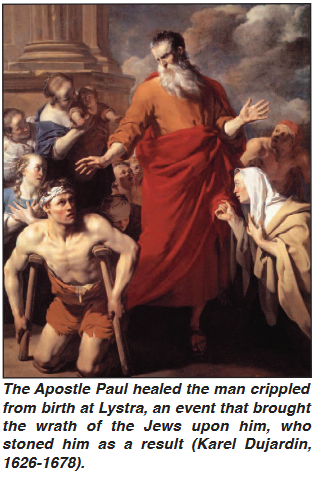
This same truth is emphasized in Acts 14:22, that “We must through many tribulations enter the kingdom of God.” Paul and Barnabas in Lystra came upon a man who was crippled since he was born; he had never walked. Once Paul told him with a loud voice, “Stand up straight on your feet!,” the people were amazed and called them gods, wanting to sacrifice for them. Paul and Barnabas calmed down the crowd, telling them they were people of the same nature as they were. Then Jews from Antioch and Iconium arrived and turned the people against Paul and Barnabas, and they stoned Paul. He was dragged out of the city, supposing he was dead. However, the disciples gathered around him, prayed, and Paul rose up to his feet and walked with them to Lystra (Acts 14:8-20). I personally believe he was indeed dead, but God raised him, for he had much yet to accomplish for God’s work in his life. A summary of Paul’s sufferings is given in II Corinthians 11:23-28. For him to attain the kingdom of God much suffering was required.
3. Our Suffering Enables Us to Experience the Sufferings of Christ.
 It is essential to our salvation that we follow in the footsteps of Jesus Christ. We are to walk as He walked (I John 2:6), and suffer as He suffered.
“For to this you were called, because Christ also suffered for us, leaving us an example, that you should follow His steps …” (I Peter 2:21).
These sufferings in Christ’s footsteps lead us to the humble attitude of not returning insults or threats in kind, but instead taking those assaults patiently (I Peter 2:19-22), and building the character as mentioned in point 1.
“Repay no one evil for evil …. Beloved, do not avenge yourselves, but rather give place to wrath, for it is written, ‘Vengeance is Mine, I will repay,’ says the Lord. Therefore, ‘If your enemy is hungry, feed him; if he is thirsty, give him drink; for in so doing you will heap coals of fire on his head.’ Do not be overcome by evil, but overcome evil with good” (Romans 12:17, 19-21).
We must endure the same sufferings that Christ endured:
“For as the sufferings of Christ abound in us, so our consolation also abounds through Christ. Now if we are afflicted, it is for your consolation and salvation, which is effective for enduring the same sufferings which we also suffer. Or if we are comforted, it is for your consolation and salvation” (II Corinthians 1:5-6).
“… that I may know Him and the power of His resurrection, and the fellowship of His sufferings, being conformed to His death …” (Philippians 3:10).
“For in that He Himself has suffered, being tempted, He is able to aid those who are tempted” (Hebrews 2:18).
“Beloved, do not think it strange concerning the fiery trial which is to try you, as though some strange thing happened to you; but rejoice to the extent that you partake of Christ’s sufferings, that when His glory is revealed, you may also be glad with exceeding joy” (I Peter 4:12-13).
We must suffer because Jesus suffered before us, and set the stage for each of us to enter the Kingdom of God just as Jesus did after suffering amidst the evils of this sinful world.
4. We Suffer so We Will Not Love This World.
As we know well, this world is consigned to Satan the Devil. He has deceived the whole world (Revelation 12:9) and perverted almost everything in it: its economic, political, religious, educational, health, and transportation systems. These perversions are rampant within all nations, and tempt the righteousness of Godly people, encouraging them to abandon Gods laws and judgments in favor of evil.
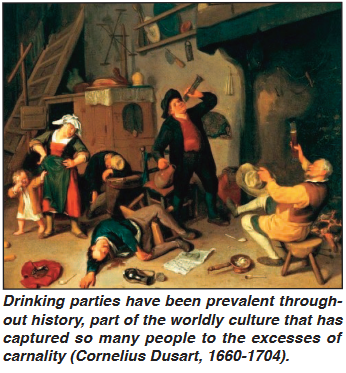 We are admonished to “Learn not the way of the heathen” (Jeremiah 10:2), but rather to avoid friendship with the world and its ways. As James 4:4 states, “Do you not know that friendship with the world is enmity with God? Whoever therefore wants to be a friend of world makes himself an enemy of God.” Notice what John has to say in I John 2:15:
“Do not love the world or the things in the world. If anyone love the world, the love of the Father is not in him” (I John 2:15).
Paul restates this matter in Romans 12:1-2, where he contrasts the life of a true believer with those who are tied to this world:
“I beseech you therefore, brethren, by the mercies of God, that you present your bodies a living sacrifice, holy, acceptable to God, which is your reasonable service. And do not be conformed to this world, but be transformed by the renewing of your mind, that you may prove what is that good and acceptable and perfect will of God.”
Paul further states in Romans 8 that this present world is subjected to futility [mataiotes, ‘transientness, depravity’; from mataios, ‘empty, profitless’] (verse 20), in bondage and corruption (verse 21), and groans and labors with birth pains (verse 22), while “… we also who have the firstfruits of the spirit, even we ourselves groan within ourselves …” (verse 23) while we await the resurrection, the redemption of our bodies when this thraldom to decay, impressed upon the earth by Satan and his minions, will be gone. That suffering through aging, sickness, mental oppression, the work of the demons and other evil spirits, drought, heat, cold, and storms, and competition and lovelessness of others will be gone!
“And God [in the new age, the New Jerusalem] will wipe away every tear from their eyes; there will be no more death, nor sorrow, nor crying. There shall be no more pain, for the former things have passed away” (Revelation 21:4).
In spite of the suffering of this age which we must endure, the Father has promised that He will not allow a temptation to utterly overtake you, but “… will not allow you to be tempted beyond what you are able [to endure], but with the temptation will also make the way of escape, that you may be able to bear it” (I Corinthians 10:13).
5. Suffering Draws Us Closer to Our Brethren, and Enables Us to Better Assist Them in Their Own Trials.
It is imperative that we love God with all of our heart, soul, and mind, and our neighbor as ourself. These two overarching principles define our entire trajectory in life, and “On these two commandments hang all the Law and the Prophets” (Matthew 22:36-40). What better opportunity do we have to love our fellow pioneers in the faith than by helping them endure through their trials? We read in I Corinthians 12:25-26 that we should have a deep and active care for one another, for “… if one member suffers, all the members suffer with it ….”
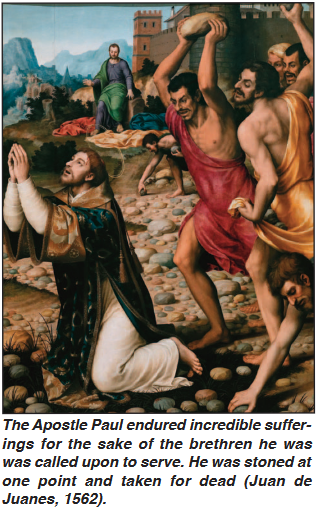
We see the great sufferings that Paul had to endure because of his commitment to serve his fellow elect. He was “… jealous for you [the Corinthian brethren] with godly jealousy. For I have betrothed you to one husband, that I may present you as a chaste virgin to Christ” (II Corinthians 11:2). He took his calling as an apostle to the gentiles very seriously — it was his entire life’s purpose — warning them of seditious intruders who wormed their way into their midst to draw away disciples to themselves, and endured incredible sufferings for the ecclesia (II Corinthians 11:23-28):
- 39 stripes [plege, “strokes, whippings”] five different times
- Beaten with rods
- Stoned
- Shipwrecked three times, and an entire day in the sea
- In perils [kindunos, “danger, peril”] from robbers, his own countrymen, and the gentiles
- In dangers in the city, countryside, and sea
- In perils from false brethren
- Coping with weariness, toil, sleeplessness, hunger, thirst, cold, and nakedness
Paul endured all of these sufferings and privations because of his “… deep concern for all the churches” (II Corinthians 11:28). Sufferings draw us closer to our brethren so we can better assist them in their trials, having experienced what they have gone through. The epitome of this suffering is that experienced by Jesus Himself when he was beaten, cursed, and marred beyond recognition (Isaiah 52:14). Because of this pain and disfigurement, He can understand even the most severe pain and abuse that we as humans can experience. We are to draw close to our spiritual brothers in their sufferings:
“Remember the prisoners as if chained with them — those who are mistreated — since you yourselves are in the body also” (Hebrews 13:3).
6. Suffering Encourages Us to Attain the Kingdom of God.
 The incredible joy of living as spirits in the New Eden — God’s Kingdom — is incomprehensible to us limited physical humans. Paul said this in I Corinthians 2:9:
“Eye has not seen, nor ear heard, nor have entered into the heart of man the things which God has prepared for those who love Him.”
Paul goes on in verse 10 to say that some things about that future world can be revealed to us through His spirit, but we can be assured He will let us peek into that world only a bit; we cannot fathom the full reality of that coming world, even as Paul stated about his being caught up in Paradise, into heaven itself:
“I know a man in Christ [Paul himself] who fourteen years agao — whether in the body I do not know, or whether out of the body I do not know, God knows — such a one was caught up in the third heaven … how he was caught up into Paradise and heard inexpressible words, which it is not lawful for a man to utter” (II Corinthians 12:2, 4).
Our sufferings in this present age drive us all the more to achieve that paradise in which the pains of this world are removed, so that the groaning and laboring with birth pangs of this current eon are removed, and we no longer groan within ourselves as we await the arrival of the glorious Kingdom (Romans 8:21-23). Our elder brother Jesus Christ had that very view of life in the flesh. He experienced the sufferings we have endured in our own physical lives (Hebrews 4:15), and therefore was qualified to die in our place — the perfect for the imperfect — so we might attain eternal life.
“… let us lay aside every weight, and the sin which so easily ensnares us, leaving us an example, that you should follow His steps” (I Peter 2:21).
We must follow in Christ’s footsteps, and run the race that involves considerable suffering:
“For to this you were called, because Christ also suffered for us, leaving us an example, that you should follow His steps” (I Peter 2:21; see also I John 2:6).
It is essential that we view the trials we face as the chastening of almighty God, who, like a loving Father, “… scourges every son whom He receives” (Hebrews 12:6). Such chastening does not seem to be joyful for the moment, but “… afterwards it yields the peaceable fruit of righteousness to those who have been rained by it” (Hebrews 12:11.
Our heavenly Father prophesied of the sufferings of Christ, and the glories that would follow (I Peter 1:11). In the same way, we must accept the sufferings that our great God allows us to experience, or might even commission an evil spirit to afflict us, like Satan afflicted Job at the Father’s allowance, or as God assigned an evil messenger to buffet Paul to keep him humble (II Corinthians 12:7-10). These sufferings are all for the purpose of moving us in the direction of the Kingdom of God so we might attain the resurrection, and rebuild Eden on earth as kings and priests (Revelation 5:10), and have our tears wiped away and remove sorrow, crying, and death from our lives (Revelation 21:4).
Our Father in heaven so greatly wants us in His Kingdom, sons of Him and brothers of Christ, sitting on the throne of Christ alongside Himself in the heavenly Zion (Revelation 3:21). That is the very purpose for which we were created, to be His sons, reigning with Him for eternity!
Why would a perfect God let you suffer? We have answered that question, and through every trial and tribulation we experience we must accept that pain as part of the great plan the Eternal has for us. We seldom will change our behavior to root out evil unless placed under stress. Painful stress moves us towards the ways of love and righteousness, truth and humility. Take the words of Peter at face value and accept our pain, which God has promised will not exceed what we can bear:
“Therefore, since Christ suffered in the flesh [and died for us], arm yourselves [like warriors] with the same purpose [being willing to suffer for doing what is right and pleasing to God], because whoever has suffered in the flesh [being like-minded with Christ] is done with [intentional] sin [having stopped pleasing the world]” (I Peter 4:1 — Amplified Bible).