


The Great Benefits of Sabbath Keeping
Even Some Animals Rest On the Seventh Day!
We live in a society characterized by considerable anxiety, anger, loneliness, fear, sickness, and depression. I could list in-depth statistics for each of these traits, but that would take up too much space for this short article. Looking at just one of these factors, depression alone in the United States affects 16% of women and 10.1% of men, many of whom take drugs or receive counseling to try and relieve their symptoms (CDC National Center for Health Statistics, Depression Prevalence in Adolescents and Adults: United States, August 2021-August 2023).
There is an antidote for all of these conditions that so few people seek, but which is readily available to everyone. That antidote is the holy Sabbath Day! In the following paragraphs I will reveal to you just how powerful the seventh day rest is for the health and well-being of us human beings made in God’s image — for He stated through Paul in III John 2, “Beloved, I pray that you may prosper in all things and be in health, just as your soul prospers.” Here we see that Paul ties physical prosperity and health to spiritual success!
 We as humans are comprised of what might be termed a three-part totality: a physical body, a mind, and a spirit, which I Thessalonians 5:23 describes from the Greek words soma (the physical body), psuche (breath, or “animal sentient principle”), and pneuma (the spirit), respectively. Let us examine how each of these aspects of the human totality are affected by observing the weekly Sabbath on a regular basis.
First, let us read the Fourth Commandment:
“Remember the Sabbath day, to keep it holy. Six days you shall labor and do all your work, but the seventh day is the Sabbath of the Lord your God. In it you shall do no work: you, nor your son, nor your daughter, nor your male servant, nor your female servant, nor your cattle, nor your stranger who is within your gates. For in six days the Lord made the heavens and the earth, the sea, and all that is in them, and rested [nuwach, ‘rest, settle down’] the seventh day. Therefore the Lord blessed the Sabbath day and hallowed it” (Exodus 20:8-11).
Sabbath Rest and the Body
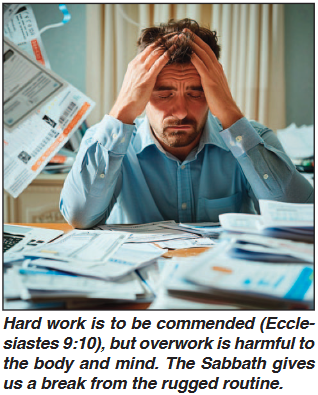
We Americans live within a fast-paced world. This manner of living has been called by some “Americanitis.” For those who strive to work hard and excel, this approach to living can be a trap. In fact, the Japanese have a word for it: karoshi, “death by overwork.” For example, a 29-year-old employee for Japan Telegraph in 1969 collapsed from a stroke six months after extreme overtime (D. Ke, Overwork, stroke, and karoshi-death from overwork, Acta Neurol Taiwan 2012 [21], pages 54-59). The World Health Organization and other labor organizations estimate that long working hours contribute to about 750,000 deaths each year worldwide.
Our society rewards overwork as a reasonable price for success in the business world, a world replete with meetings, telephone calls, iPhone addiction, report deadlines, automobile and air travel, and scant attention to family matters. Yet, the body requires time for rest and meditation, as scientific studies have proven.
In 2025 a study by O’Riordan et. al. (Religious and spiritual coping mediates the association between trait extraversion and cardiovascular reactivity to acute psychological stress, Journal of Religion and Health 64 [6], pages 4824-4846), involving 139 spiritually oriented people, showed that those who engaged more in religious social coping exhibited lower systolic blood pressure, diastolic blood pressure, and MAP reactivity to acute stress. High trait extraversion (the tendency to seek stimulation and gain energy from social interactions) was associated with greater religious and spiritual coping and improved cardiac function.
A 2012 Lancet study (Kivimaki et. al., Job strain as a risk factor for coronary heart disease: a collaborative meta-analysis of individual participant data, Lancet 380 [9862], pages 1491-1497) followed more than 190,000 individuals and reported that high job strain was associated with a significantly higher risk of coronary heart disease. Other similar studies have shown an increase in the risk of stroke and heart disease among people consistently working over 55 hours per week since sustained mental pressure elevates blood pressure, raises cortisol levels, and restricts blood vessels.
 A fascinating study by Zarina, et. al. (Living by the clock of the book: religious observance enhances circadian stability and reduces social jetlag in older adults, a cross-sectional study, BMC Public Health 25 [2607], 2025) compared sleep patterns of 473 Sabbath-keeping Jews with secular adults. The religious participants reported going to sleep earlier, enjoying longer sleep periods on Sabbath days, and more consistent sleep-wake behavior, which promotes circadian suability that is widely recognized as essential for physical health.
Moreover, in 2005 National Geographic published results from a study by the U. S. National Institute on Aging (The secrets of living longer, November, 2005), that revealed facts about people living in so-called “Blue Zones,” areas where people live longer than in surrounding areas. The only Blue Zone found to exist in the United States was Loma Linda, California, home for a large community of Seventh-Day Adventists. Most of the residents are Sabbath keepers. The study revealed that Adventist men lived about 7.3 years longer, and women 4.4 years longer, than their non-Sabbath-keeping California counterparts, which researchers attributed to consistent, faith-driven lifestyle habits practiced every week throughout their lives.
These results follow on the heels of a study of Seventh-Day Adventists from 1976 to 1988, which evaluated diet, exercise, body mass index, past smoking habits, and hormone replacement therapy (in women). The Adventists lived up to 10 years longer than other Caucasian Californians, showing that Sabbath keeping, and associated lifestyle practices related to Biblical principles, drastically improved longevity and, assumedly, overall health.
As N. Cloud summarized in the article Sabbath rest in Explore the benefits of Sabbath rest (www.amazing facts.org):
“Continuous activity contributes to physical strain, including weakened immune function, poor sleep, and increased risk of cardiovascular disease. Current research supports the restorative effects of Sabbath observance, which allows the body to recover rather than remain in a constant state of overwork.
“Sabbath-keeping is also linked to longevity and greater productivity. It is presented not as optional downtime but as a necessary practice for maintaining health. The Sabbath functions as intentional care for the body God created. Weekly rest is built into His design for human well-being.”
Sabbath Rest and the Mind
We live in a world bombarded by all sorts of negative events and discouraging influences. What else can we expect from the arch-enemy of love and family who is the god of this world (II Corinthians 4:4; Ephesians 2:2)? How does keeping the Sabbath Day counter these demoralizing frequencies of the Devil?
A laboratory study with rats showed that prolonged stress caused the animals to lose interest in the things they normally enjoyed: sugary foods, play, socializing, and similar uplifting activities. These changes mirror the major symptoms of human depression. The study also revealed that by removing the stress, the rats’ behavior returned to normal, especially when combined with rest and socializing, showing that the removal of excess stress over time is necessary to heal a worn-down mind (E. Erasian, et. al., Home-cage behavior is implanted by stress exposure in rats, Frontiers in Behavioral Neuroscience 17, June 8, 2023; other sources).
 Amazingly, nearly 20% of adults in the United Stated experience a mental illness each year, and over 280 million people around the world live with depression (Anonymous, Global depressing statistics, Worldmetrics Report, 2026, www.worldmetrics.org). The cost of depression to society is estimated to be $1 trillion, yet most receive little or no treatment. These mental health challenges — anxiety, depression, and emotional fatigue — continue to climb as the years pass, causing record increases in funding for mental health research (M. Fernandez, Mental health statistics in the U. S. 2025, Nola Defender, October 15, 2026, www.noladefender.com).
While the causes for mental illnesses are many and varied, an obvious cause for such heartache is the failure to rest our minds. Is not this the reason our heavenly Father gave us the seventh day rest? This command — “Remember the Sabbath day to keep it holy” (Exodus 20:8) — refers to not only ceasing from our servile work, but also escaping for a day from our problems, pressures, and mental anxieties that living in the twenty-first century brings to us.
The Eternal Living God promises that anyone who trains his mind on Him will be kept in “perfect peace” (Isaiah 26:3). How is this possible within a world replete with continually negative news reports of violence, murder, wars, and other conflicts where athletes and the rich, politically powerful and often corrupt individuals are paraded as models of living?
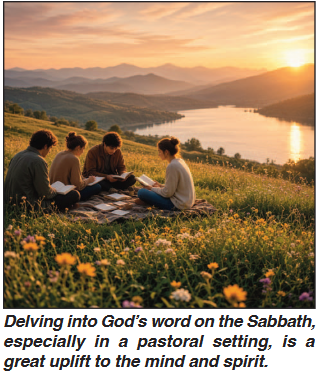
Enter the Sabbath rest! Leviticus 23:3 states, “Six days shall work be done, but the seventh day is a Sabbath of solemn rest, a holy convocation” [miqra, “something called out, i. e., a public meeting, the act, the persons, or the place”). God’s people are commanded to assemble on the seventh day, in homes or in public places — for what? For encouragement of one another, for expressing love to one another, and for uplifting our fellow man even as we love our heavenly Father above all else (Matthew 22:36-40; I Thessalonians 4:18; 5:11). This weekly “holy convocation” with brethren, in the process of orienting our minds around our Creator God, is strongly associated with significantly lower rates of depression, while granting greater fulfillment and sense of purpose in living.
For instance, a study in the year 2010 entitled Social relationships and mortality risk (J. Holt-Lunstad et.al., PLOS Medicine, www.doi.org/10.1371/journal.pmed.1000316) revealed that social isolation carries health risks comparable to smoking 15 cigarettes a day! The study reveals how positive social interaction is a great motivator of emotional health and longevity.
Moreover, group singing, as during a Sabbath gathering, has been shown to trigger the release of endorphins, which accelerate social bonding and the sense of belonging. A study by Pearce et. al. (The ice-breaker effect: Imaging mediates fast social bonding, Royal Society Open Science 2 [10]: 150221, 2015), concluded that:
“This [the study results] represents the first evidence for an ‘ice-breaker effect’ of singing in promoting fast cohesion between unfamiliar individuals, which bypasses the need for personal knowledge of group members gained though prolonged interaction.”
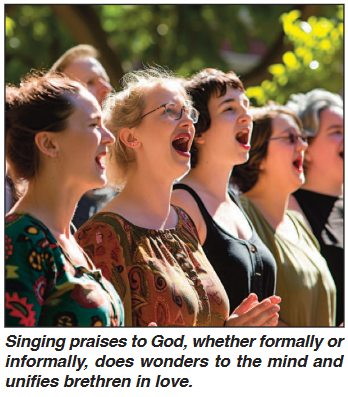 Thus, we see the value of Paul’s admonition in Ephesians 5:19:
“… speaking to one another in psalms and hymns and spiritual songs, singing and making melody in your heart to the Lord ….”
To amplify the value of fellowship and its value in removing isolation and depression, singing is emphasized by Paul for gatherings of God’s people: “Whenever you come together, each of you has a psalm, has a teaching, has a tongue, has a revelation, has an interpretation.” James emphasizes the need for singing even more when he stated, “Is anyone among you suffering? Let him pray. Is anyone cheerful? Let him sing psalms” (James 5:13).
The Sabbath day fosters family ties amidst a week full of work, school activities, chores, and other commitments, fragmenting the time parents and children spend together in true fellowship — time when the communication of God’s truth should be shared. In fact, such teaching is commanded for God’s people:
“And these words which I command you today shall be in your heart. You shall teach them diligently to your children, and shall talk of them when you sit in your house, when you walk by the way, when you lie down, and when you rise up” (Deuteronomy 6:6-7).
Structured family time is indeed a major issue God has reserved for parents and children — to the benefit of both. A Columbia University professor showed that children brought up amidst a regular spiritual family schedule showed remarkably lower rates of depression, anxiety, and substance abuse, while being more resilient in dealing with challenges all young people face (L. Miller, A “strong spiritual core,” Maria Shriver, 2026, www.mariashriver.com).
Not only is a properly functioning family unit itself a great barrier to mental problems, but families associating with a like-minded community on the Sabbath day — through acts of service to those in need who are ill, oppressed, orphaned, or otherwise suffering (see James 1:27) — experience less stress and depression, lower cortisol levels and blood pressure, and more satisfying lives (K. Kruse, New research suggests that spirituality might be the ultimate resilience advantage, www.forbes.com, July 15, 2026). In fact, special blessings are promised to those who keep the Sabbath properly — not in isolation as is the practice of some (Hebrews 10:25). As Isaiah 58:13-14 states:
“If you turn away your foot from the Sabbath, from doing your pleasure on My holy day, and call the Sabbath a delight, the holy day of the Lord honorable, and shall honor Him, not doing your own ways, nor finding your own pleasure, nor speaking your own words, then you shall delight yourself in the lord; and I will cause you to ride on the high hills of the earth, and feed you with the heritage of Jacob your father. The mouth of the Lord has spoken.”
For maximum positive psychological effects of Sabbath keeping it is best to fellowship in a natural outdoor setting. A study by G. Meredith, et. al. (Minimum dose time in nature to positively impact the metal health of college-aged students and how to measure it: a scoping review, Frontiers of Psychology 10, January 13, 2020) revealed that an excellent way to rest the mind is to walk within the natural world and observe the handiwork of God, for “The heavens declare the glory of God: and the firmament shows His handiwork” (Psalm 19:1), and “… His invisible attributes are clearly seen, being understood by the things that are made …” (Romans 1:20). According to Meredith, et. al.:
“These studies show that, when contrasted with equal durations spent in urbanized settings, as little as 10 minutes of sitting or walking in a diverse array of natural settings significantly and positively impacted defined psychological and physiological markers of mental well-being for college-aged individuals. Within the included studies, 22 different measures were used to assess the effects of nature doses on mental health and well-being.”
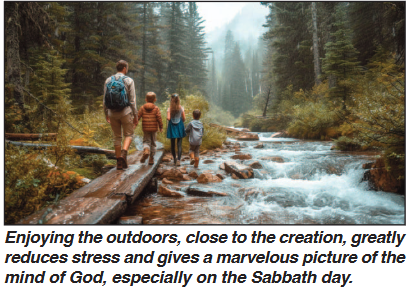 As one writer stated regarding getting out into the natural world on the Sabbath day (Anonymous, How weekly rest impacts mental health, www.sabbattruth.com):
“As little as 10 to 20 minutes spent in a natural setting can meaningfully reduce stress, anger, and anxiety, while light movement releases endorphins that actively combat low mood. This reduces neural activity in the brain region associated with rumination: the exhausting mental habit of replaying problems, failures, and worries in an endless loop. Use your Sabbath walk as dedicated time to pray and converse with God, and you will find ‘the peace of God which surpasses all understanding’” (Philippians 4:7).
Sabbath Rest and the Spirit
Perhaps the greatest benefit of all from Sabbath keeping is uplifting the spirit the Eternal has placed within you. We know the character of that spirit: It is the very character of Jesus Christ and our heavenly Father. Many of these qualities are summarized in Galatians 5:22-23:
Love Patience Faithfulness
Joy Kindness Gentleness
Peace Goodness Self-control
Add to these humility, proper judgment, mercy, and other God-plane qualities and we have a vivid picture of the very nature we must possess to be the children of God. It is the very personage of the Creator living within us (II Corinthians 6:16; Galatians 2:20)!
While this life in Christ must continue 24 hours a day, seven days a week, yet it is on the seventh day — the weekly Sabbath — that we can rest from our labors and focus deeply upon these qualities that make us the special people that we are: “… a chosen generation, a royal priesthood, a holy nation … that you may proclaim the praises of Him who called you out of darkness into His marvelous light” (I Peter 2:9).
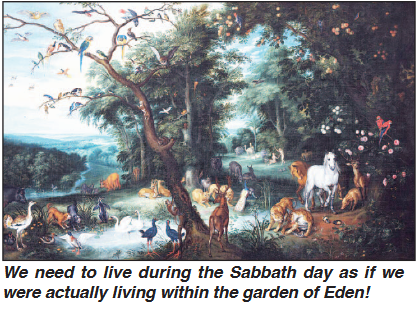 It is during our Sabbath fellowship that we are to fulfill the very nature of living within the upcoming Kingdom God will establish on earth (Isaiah 58:13).
– Desisting from servile work required by the merchandising system installed by Satan the Devil (see also Ezekiel 28:16-18)
– Doing God’s pleasure, not your own
– Making the day a delight, holy and honorable
– Not speaking your own words, but the Eternal’s precepts
It is during this 24-hour day that we lay aside any earthly trappings and live, as it were, within the garden of Eden that will be established in the coming age, and which Adam and Eve lost due to sin 6,000 years ago. The Creator knows we need this time to “recharge our spiritual batteries,” while living within a world rife with the pulls of the flesh embedded deeply within a sin-filled world, wherein Satan reigns (II Corinthians 4:4; Ephesians 2:2; Matthew 4:8-9).
The conduct of Sabbath fellowship, as it should be done, is a unique recipe for building the spirit. Notice what Paul indicates we should include within congregational gatherings:
(1)Prophesying [propheteuo, “speak under divine inspiration”] by anyone moved by the spirit (I Corinthians 14:1, 39)
(2) Singing of psalms (I Corinthians 14:26)
(3) Teaching God’s truths (I Corinthians 14:26)
(4) Speaking in other languages if there is an interpreter (I Corinthians 14:26-27)
All of these Sabbath functions promote the exercise of the spirit within us, and the utilization of the spiritual gifts granted to all of us. Many of these gifts, but certainly not all of them, are outlined in I Corinthians 12:
Healing
Administering
Teaching
Speaking in tongues [glossa, “a language”]
Prophesying (inspired speaking)
Wisdom and knowledge
Working miracles [dunamis, “exercise spiritual power”]
Interpreting tongues
These gifts are not optional to be expressed, but are required of God’s elect to be expressed for the benefit of other brethren. As Peter said in I Peter 4:10, “As each one has received a gift, minister it to one another, as good stewards of the manifold grace of God.”
Truly, the Sabbath day is a marvelous blessing granted by the Creator to all of humankind, if they would but follow His instructions. It is such an imperative command that even the creation shouts for the truth of this marvelous day!
God’s Sabbath Stamp on Creation
We can begin this uncovering of the Sabbath command in the creation by noting that in the Pentateuch there are seven distinctive Sabbath commands that relate to the entire creation (R. Davidson, God’s Sabbath stamp, Adventist Review, December 3, 2018):
(1) Creation (Exodus 20:8-11)
(2) Redemption (Deuteronomy 5:12-15)
(3) Humanitarian concerns (Exodus 23:12; Deuteronomy 5:13-14)
(4) Sanctification and celebration (Exodus 31:13-16)
(5) Freedom from all work (Exodus 35:2-3)
(6) Family and faith ties (Leviticus 19:3)
(7) Public worship (Leviticus 23:3)
We can go beyond these revelations and note some discoveries within the creation that point to the seventh day cycle, expressed in some interesting places.
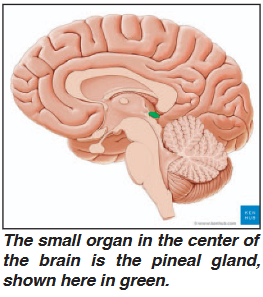 1. The pineal gland and the Sabbath. Several scientists, especially K. Greenaway, have researched how the pineal gland, which is situated within the brain, possesses a seven-day rhythm of secreting melatonin that peaks on Saturday (K. Greenaway, Understanding the Biblical concept of time and spiritual rest, unpublished paper, January 2015, pages 9-14; S. Hans-Georg, et. al., Evidence for a circaseptan and circasemiseptan growth response to light-dark cycle shifts in nucleated and enucleated Acetabularia cells, respectively, Proceedings of the National Academy of Science USA, Cell Biology 83 [1986], pages 8619-8623).
This extra release of melatonin on the Sabbath day, due to its calming and mood-enhancing effects, is conducive to rest, tranquility and enhanced fellowship experience, showing the seventh day of the week to be specially blessed from the creation! Greenaway postulated:
“… based upon this research … God’s one-time stimulus of blessing and sanctifying the seventh day at Creation may have evoked a literal physiological, endocrinological, and immunological response in the pineal gland with increased melatonin output on that initial seventh day [at the creation of Genesis 1], something that may conceivably be amplified at each subsequent seventh day.”
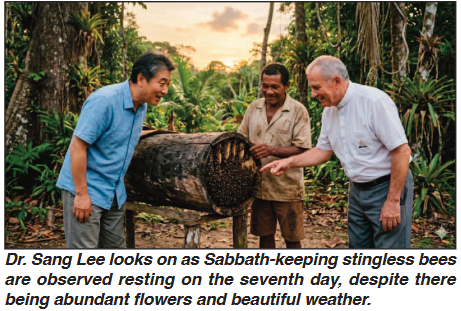 2. Honey bees and the Sabbath. The fact that a certain species of honey bees rests on the seventh day lends evidence to the idea that Sabbath keeping was imprinted into the entire creation of animals and insects, as well as mankind, as we note in the previous paragraphs. Dr. Sang Lee, an American physician, came to believe that because God created a perfect world — He called the creation “very good” in Genesis 1:31 — with the seventh-day rest culminating the six days of creation, both mankind and all animals instinctively rested on the seventh-day Sabbath; it was imprinted into them, for He Himself rested from His labors that day. Unfortunately, when sin appeared on earth, pain and death and their associated chronic fears and stresses over the centuries led to a gradual eradication of this natural instinct.
However, Dr. Lee believed that in spite of the negative effects of sin, some species of animals, especially those living in peaceful, danger-free, pure environments, could still possess the Sabbath rest instinct. While in Brazil presenting a health seminar, he was told of a certain beekeeper who maintained hives of stingless bees in the remote Amazon rainforest … bees that never worked on the Sabbath! Intrigued by this story, Dr. Lee was driven to this rainforest locale and met the beekeeper, a kind and humble man who lived in a beautiful natural house without glass window, who ate only fresh produce straight from his garden. The story continues (S Gromadzki, Sabbath-keeping bees and divine instinct, Salvation 1, www.salvation1.com):
“When Dr Lee arrived there it was still Sabbath, so he wanted to see with his own eyes that the bees were really resting. And sure enough, although there were many hives in that apiary, there were no bees seen around in the field. He was very excited about it and wanted to learn as much as possible, so he told the pastor to ask the beekeeper to open one of the beehives so that he could see if the bees were there. The beehives were made of empty tree stumps and on the top they were sealed with a lump of clay. Encouraged by the beekeeper, Dr Lee put his ear to one of the holes made in the clay, and when he did he could hear a clear buzzing noise made by bees inside the hive. It was amazing that none of them was trying to get outside, although it was a very sunny and bright day with plenty of colorful flowers around.
“Then Dr Lee asked that man when the bees stop working and start their Sabbath rest. The answer he received made him even more thrilled as the beekeeper answered that the bees always stop working exactly at the sunset every Friday. It was so amazing! Bees keeping the fourth commandment and resting on every Sabbath beginning from the sunset on Friday, exactly as the Lord commanded in His Word (Leviticus 23:32; Genesis 1:5, 14; Mark 1:32; Matthew 28:1).
“Intending to demonstrate that nothing could stop the obedient insects from observing the Sabbath rest, the keeper made a large opening in the clay part of the hive. Through that opening Dr Lee could now see thousands of bees resting in the hive, and in spite of the disturbing noise and damage they kept on staying there. Only a few of them came outside but returned after a very short time.”
Dr. Lee was told that the hives could easily be moved on the Sabbath when the bees were docile, but on weekdays not so! He even found them gentle when picked up by hand on the Sabbath. He was told not to be afraid of being stung, since they were a stingless species of the Melipona genus.
3. Birds and the Sabbath. Myles Willard is a nature photographer of note who made an unexpected discovery while looking out the window of his Michigan home. Each fall he carefully tracks the number of migrating warblers that stop by for a rest in a big cedar tree in his yard. After tracking over 1,500 warblers for 18 years, he noticed a statistically significant drop in the number of birds stopping every Sabbath day! As stated in Creation moments — Do birds take a Sabbath rest? (Lee, August 19, 2016, www.leesbird.com/2016/08/19):
“Did these migrating birds have a built-in instinct that somehow made them follow the biblical principle of a Sabbath rest? We are not saying, of course, that the warblers were knowingly obeying God’s fourth commandment. However, if God worked for six days and then rested on the seventh, why would it be hard to believe that God gave these birds a cycle of six days of work followed by a seventh day of rest?”
 4. Beavers and the Sabbath. A study over many years by Larren Cole at a park in south-central Oregon followed a colony of beavers, to examine their activities during the week. Every Sabbath day the beavers did not leave their lodge, but vigorously worked on dam, lodge construction, and food gathering the other six days of the week during the warm season of the year. His observations are recorded on a DVD documentary which has been shown worldwide (www.desiremedia.org/index). Larren believes that, like the birds and bees cited above, the beavers’ Sabbath behavior is directly linked to instinctual behavior implanted into them and all creatures during their creation.
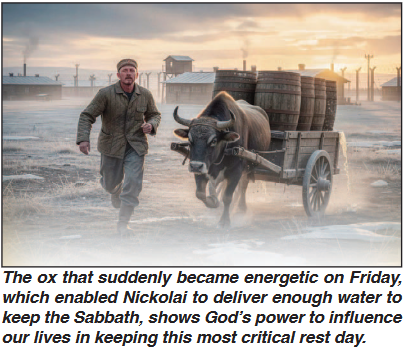 5. An ox and the Sabbath. The author Bradley Booth wrote a book entitled (The Miracle of the Seventh-Day Ox, www.lastgen.net/articles/the-miracle-of-the-seventh-day-ox/). This fascinating story is of a prisoner named Nickolai Panchuk, a church pastor from Kiev, Ukraine, who had been sent to a concentration camp in Siberia where he worked as slave labor with other prisoners. Even then he refused to work on the Sabbath, so the guard would mercilessly whip him. This occurred weekly, and the furious warden harshened the punishment by confining him inside a wooden box barely large enough to fit him — for 10 days at a time. He could not stand up, lie down, or straighten his legs. Nicolai refused to buckle to the warden’s demands, keeping the Sabbath through prayer and faith that something good would result from his suffering.
This confinement continued for two years — he miraculously did not die from the brutal treatment — until finally a visiting colonel walked into the barn where he was held, saw his plight, and took pity on Nicolai, and arranged for him to be the water carrier from a spring 1.5 miles from the camp. The barrels of water were transported in a cart by a slow, lumbering ox named Maksim. Now Nicolai worried that he might not be able to carry enough water by Friday evening so he could keep the Sabbath with such a slow-moving ox; he might be thrown into the box once again.
“When Friday morning came, Nickolai couldn’t believe his senses! Maksim was impatient to go and set off at a run. Nickolai could barely keep up with him! All day the ox worked frenziedly, so by sunset they actually had enough water for the Sabbath. It was a miracle! Nickolai recalled the Bible verse, ‘Not by might nor by power, but by My spirit, says the Lord of hosts’” (Zechariah 4:6).
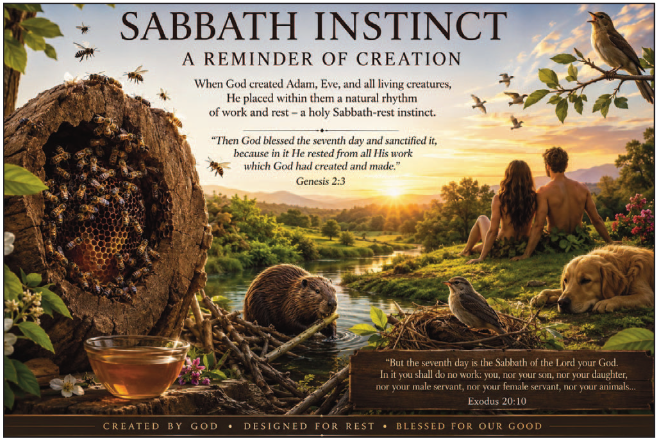
There are many other observations that have been made showing the mind of God’s Sabbath keeping imprinted within the creation. These are strong confirmations that indeed “The Sabbath was made for man, not man for the Sabbath” (Mark 21:27).
Sabbath Keeping Is Essential!
We as God’s people need to faithfully observe the weekly Sabbath, not only because the Eternal has commanded us to but because of its wonderful benefits to us personally in body, mind, and spirit. We have discussed bees, birds, beavers, and oxen that have been shown to keep “circaseptan [seven-day] rhythms,” not governed by the sun and moon, but by some sort of implanted feature preserved through multiple generations. That rhythm is even evident with people, whose pineal gland maintains a seven-day cycle of melatonin production, creating a natural rhythm of work and rest. We must admit that sin and stress through 6,000 years of Satan’s influence in the world could gradually weaken the original Sabbath-rest instinct of both humans and animals. As stated by S. Gromadzki (www.salvation1.com):
“This [world filled with fear over millennia] may explain why most people and animals no longer show any clear natural desire to rest on the seventh day …. The peaceful stingless bees of the Amazon, the birds that reportedly stop nest-building on the Sabbath, the beavers that seem to rest on Saturday, and similar accounts may be small but beautiful reminders of the harmony that once existed in Eden.”
Let us keep the Sabbath day holy, to experience the great benefits to our body, mind, and spirit as we go through life, glorifying the great Creator who made us in His express image. By following the Eternal’s command to keep the Sabbath rest we can expect to live healthier, experience less stress, enjoy more fulfilling fellowship with true friends, conquer depression and emotional trauma, and express more fully the fruits of kindness, joy, peace, love, and humility. Our great God knew we needed that special time when He made us, even as He Himself enjoyed the Sabbath rest after six days of creation (Genesis 2:2-3).
Let us walk in the Creator’s footsteps and keep the Sabbath rest. He made it especially for us, a command alongside the other nine, for our own good and the good of everyone around us!