

Our Heavenly Father’s Care for Us!
It Goes Much Deeper Than We Can Possibly Imagine
It is easy for us to slip into negative thoughts in this world of trial and suffering. So many people deny the power of God in their lives, and His works throughout the world, and consequently suffer depression and hopelessness, seeing no sense or great purpose for living than to be born, to live, and then die with nothing beyond the grave. Living with such grim prospects has got to be painful, viewing nothing worthwhile living for beyond the present — nothing to strive after except self-glorification. Even that has no real foundation in their minds.
Thankfully there is truth which teaches us that such vain thoughts are without merit. All of creation shouts forth the joyous message of the Eternal’s existence, and His plan to retrieve mankind from this earthbound physical state and ultimately place him into the heavenly realm —each in his own order:
“For since the creation of the world His invisible attributes are clearly seen, being understood by the things that are made, even His eternal power and Godhead, so that they [ungodly men who suppress the truth in unrighteousness] are without excuse …” (Romans 1:20).
Because these unrighteous people deny the reality of their existence and the future God has planned for them, they shield themselves from the incredibly powerful truths of our heavenly Father’s plans for them. They fail to see the reality of who they are, why they are here on earth, and the purpose for which they were created. They fail to comprehend the depth of the Creator’s care for us.
Let us take a close look at how our heavenly Father views us, His creations who are destined to become sons of God, even as Jesus Christ is the Son of God (John 1:12; Romans 8:29). The elect are drawn by the Father to come to Jesus Christ (John 6:44), first the firstfruits who will be raised in the first resurrection (James 1:18; Revelation 14:4) — a better resurrection,” as Paul put it (Hebrews 11:35) — and after the 1,000-year Kingdom the rest of the dead (Revelation 20:12-13).
The Father’s Boundless Love for Us
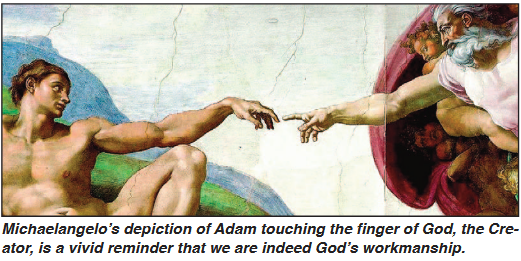 Let us examine carefully from Scripture the Father’s incredible care for each of us.
1. We are the Father’s workmanship, made in His image. As His image-bearers, we are like Him in our composition: like Father, like son:
“Then God said, ‘Let Us [Elohiym, ‘gods in the ordinary sense, especially the supreme God’] make man in Our image, according to our likeness [dmuwth, ‘resemblance, model, shape, like’] …. So God created man in His own image; in the image of God He created him; male and female He created them” (Genesis 1:26-27).
 The Father was most certainly an integral part of this creation, since “You created all things” (Revelation 4:11), although other Elohim were involved, most notably Jesus Christ (Ephesians 3:9; Colossians 1:16). Isaiah 45:12 states that “I [Lord = Yhwh, ‘the self-Existant or Eternal, name of God’] have made the earth, and created man on it.’” Isaiah 43:7 confirms this. Yahweh can mean the Father, Christ, or some other members of Elohim, for they were involved in the creation of Genesis 1. Moreover, Jesus stated, “He who has seen Me has seen the Father …” (John 14:9), and indeed, when Ezekiel witnessed the throne of the Father he saw “… a likeness with the appearance of a man high above it …” (Ezekiel 1:26). This appearance is elaborated upon in verses 27 and 28, and bears a resemblance to a description of the glorified Jesus Christ in Revelation 1:13-16, and the Ancient of Days in Daniel 7:9. It makes sense that the glorified spirit bodies of the Elohim would be similar to one another, charged with energy, brilliant colors, lightning, white hair, shining body coverings, and a powerful voice.
We are destined to some day be like Him! Today as flesh and blood we are the clay and our heavenly Father is the potter. We are the work of His hands (Isaiah 64:8). That clay will be transformed into the Father’s own image in the spirit because of His boundless love for us!
2. Our Father loves us and cares for us deeply. Even from the womb he cares for us to old age, as Isaiah 46:3-4 so eloquently states:
“Listen to Me, O house of Jacob, and all the remnant of the house of Israel, who have been upheld by Me from birth, who have been carried from the womb: even to your old age, I am He, and even to gray hairs I will carry you! I have made, and I will bear; even I will carry, and will deliver.”
We know that Jeremiah was set apart and known by the Eternal even before he was formed in the womb (Jeremiah 1:5). So was Isaiah (Isaiah 49:1, 5), and very likely all of us who have been called into the body of Christ were likewise known before we were born, even before conception. That is what Ephesians 1:4-5 appears to be saying:
“Just as He chose us in Him before the foundation [katabole, ‘a disposition, i.e. founding, conception’] of the world [kosmos, [‘orderly arrangement’], that we should be holy and without blame before Him in love, having predestined [proorizo, ‘predetermined’] us to adoption as sons by Jesus Christ to Himself, according to the good pleasure of His will …” (see also verse 9).
Paul in Romans 8:29-30 concurs with these words to the Ephesians, — refering to the elect as being predestined [proorizo] “… to be conformed to the image of His Son, that He [Christ] might be the firstborn among many brethren” (verse 29). These statements require a preexistence of the saints in some form before their conception, a weighty consideration indeed, but God’s thoughts and plans transcend our thoughts.
Our heavely Father’s care and love for us is beyond our comprehension! Consider first of all that we are His workmanship. We would not even be here to consider these thoughts and words without His creation of us! The Scriptures that elucidate this agape love are numerous. Let us review a few of these.
“Behold what manner of love the Father has bestowed on us, that we should be called children of God! Therefore the world does not know us, because it did not know Him: (I John 3:1).
“Beloved, let us love one another, for love is of God; and everyone who loves is born of God and knows God. He who does not love does not know God, for God is love” (I John 4:7-8).
“In this the love of God was manifested toward us, that God has sent His only begotten Son into the world, that we might live through Him. In this is love, not that we loved God, but that He loved us and sent His Son to be the propitiation for our sins. Beloved, if God so loved us, we also ought to love one another” (I John 4:9-11).
“And we have known and believe the love that God has for us. God is love, and he who abides in love abides in God, and God in him” (I John 4:16).
“We love Him because He first loved us” (I John 4:19).
 “… for the Father Himself loves you, because you have loved Me [Christ], and have believed that I came forth from God” (John 16:27).
“For whom the Lord loves He corrects, just as a father the son in whom he delights” (Proverbs 3:12).
“And because He loved [ahab, ‘to have affection for’] your fathers, therefore He chose their descendants after them; and He brought you out of Egypt with His Presence, with His mighty power” (Deuteronomy 4:37).
“And I have declared to them Your name, and will declare it, that the love with which You loved Me [Christ] may be in them, and I in them” (John 17:26).
“Jesus answered and said to him, ‘If anyone loves Me, he will keep My word, and My Father will love him, and We will come to him and make Our home with him” (John 14:23).
These are just a few of the evidences of the Father’s love for us. The word love is a powerful word, agape in Greek, that has the following nuances:
- Love is the attitude of God toward His Son (John 17:26), the human race (John 3:16; Romans 5:8), and to the elect in particular (John 14:2).
- Love is His will to His children concerning their attitude toward one another (John 13:34), and toward all men (I Thessalonians 3:12; I Corinthians 16:14; II Peter 1:7).
- Love is God’s desire for the elect to express His essential nature (I John 4:8).
- Love can only be known from the actions it prompts (I John 4:9-10).
- Love acts even in spite of the lack of perfection in its objects (Romans 5:8).
- Love has its perfect expression among men in the person of Jesus Christ (II Corinthians 5:14; Ephesians 2:4; 3:19; 5:2).
- Christian love has God as its primary object, and expresses itself first of all in obedience to His commandments (John 14:15, 21, 23; I John 2:5; 5:3; II John 6).
- Love seeks the welfare of all (Romans 15:2), and to do good to all men, especially to the elect (Galatians 6:10).
3. Our Father is our Savior: “For I am the Lord your God, the Holy One of Israel, your Savior [yasha, ‘to be open, wide, or free, i.e., to be safe’]” (Isaiah 43:3). He made us for Himself: “This people I have formed for Myself” (Isaiah 43:2). As such, we owe everything we are to Him, since we would not exist were it not for His creation of us.
 Why did He make us? It had to be out of His love for us, to multiply that love by millions and billions of times, to increase Himself, as it were … for, “Of the increase of His government and peace there will be no end” (Isaiah 9:7). All through the creation we see the principle of reproduction and increase. It is His nature of love to multiply that love forever and ever.
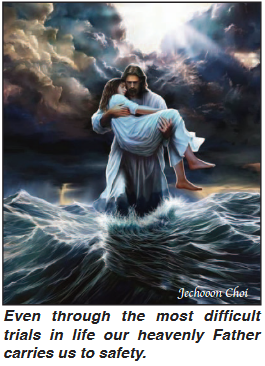
Being a savior means He will not only deliver us ultimately from the clutches of death (“the soul who sins shall die”; Ezekiel 18:4, 20) into the eternal heavenly realm at the resurrection. He will deliver us through trials, even from conception to old age!
“Even to your old age, ‘I am He, and even to gray hairs I will carry you. I have made, and I will bear; even I will carry, and will deliver you’” (Isaiah 46:4).
“For He bruises, but He binds up; He wounds, but His hands make whole. He shall deliver you in six troubles, yes, in seven no evil shall touch you. In famine He shall redeem you from death, and in war from the power of the sword. You shall be hidden from the scourge of the tongue, and you shall not be afraid of destruction when it comes” (Job 5:18-21).
“Many are the afflictions of the righteous, but the Lord delivers him out of them all. He guards all his bones, not one of them is broken” (Psalm 34:19-20).
“Surely He shall deliver you from the snare of the fowler and from the perilous pestilence. He shall cover you with His feathers, and under His wings you shall take refuge; His truth shall be your shield and buckler …. A thousand may fall at your side, and ten thousand at your right hand; but it shall not come near you” Psalm 91:3-4, 7).
Our heavenly Father’s care for us is endless! He made us, and He sustains us through all trials — through sickness, wars, famines, pestilence, and attacks from every side. Those trials have been engineered by the Adversary, the god of this world (II Corinthians 4:4; Ephesians 2:2), who “… walks about like a roaring lion, seeking whom he may devour” (I Peter 5:8). Of course, we must do our part by resisting him so he will flee from us (James 4:7), which requires us to submit to God and draw near to Him, cleanse our hands of all sin, and purify our hearts (James 4:8). These things we will do through the power of God’s spirit living within us.
He Shows Us How to Live As Families
Just as our heavenly Father loves us and cares for us, He also shows us how to care for those around us, especially our physical families and those in the faith. Thus, we can confidently say that the roles of fathers and mothers directly parallel the roles of Christ and the ecclesia:
“But I want you to know that the head of every man is Christ, the head of woman is man, and the head of Christ is God [the Father]” (I Corinthians 11:3).
head = kephale, “the head.”
 The head
Woman……………..Man
The elect………Jesus Christ
Jesus Christ…. The Father
The nature of this headship — not a domineering or authoritarian relationship — is based upon love in its most magnificat and glorious form. Ephesians 5:22-23: shows how deep and profound this relationship is.
- The wife must submit to the husband in everything.
- The husband is the savior of the wife. Savior = soter, “deliverer; i.e., God or Christ”; from sozo, “a deliverer.”
- The husband must love [agapao] the wife as he loves himself. Agapao implies having a preference for someone above all others.”
- The husband must be willing to die for the wife, even as Christ did for the elect.
- The husband must sanctify [hagiazo, “to make holy, purify, consecrate”] and cleanse [katharizo, ” to cleanse”] the wife through his words [rhema, “to utter, speak, or say”], which ought to be God’s words.
- The husband must strive to help purify his wife to be blemish-free.
- The husband must love his wife as his own body, and nourish [ektrepho, “rear up to maturity”] and cherish her [thalpo, “warm, brood, foster”].
- The wife must respect [phobeo, “frighten, be alarmed, be in awe of, revere”] her husband.
While headship is critical in the husband-wife, Christ-ecclesia, and Father-Christ relationships, the mutual respect and honor for the other cannot be minimized, for Paul indicates in Ephesians 5:21 that the husband and wife are to submit [hupotasso, “to subordinate, to obey”] to each other. This does not imply that they are equals, but certainly they are to practice the “Golden Rule”:
“Therefore, whatever you want men to do to you, do also to them, for this is the Law and the prophets” (Matthew 7:12).
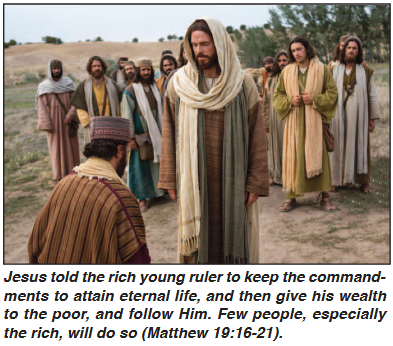 Matthew 22:40 restates this truth, after Jesus had told the lawyer what is the great commandment in the law: “Love the Lord your God with all your heart, with all your soul, and with all your mind …. And the second is like it: You shall love your neighbor as yourself” (Matthew 22:37-39).
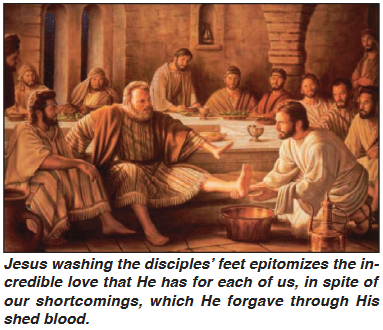
While it is obvious that the Father is greater than His Son Jesus Christ and to the elect — His sons, the firstfruits — it is also true that it is love that binds us together, so that we reside within each other, as it were: “… that they all may be one, as You, Father, are in Me, and I in You, that they also may be one in Us …” (John 17:21). When Jesus washed the disciples’ feet Passover night before His crucifixion, He dramatically revealed that He did not consider Himself to be “above” or “greater than” those disciples (and by extension, us), but looked upon them as brothers (see Romans 8:29), esteeming them as better than Himself (Philippians 2:3).
So, we vividly see that human fathers are placed in a role analagous to that of our heavenly Father. We are learning to be like Him, our Creator, and to do His will, even as Jesus Christ came to do the Father’s will (John 5:19). What Christ teaches us in the Scriptures is a witness to the Father’s will.
The family and children teach us so much of what our heavenly Father desires for us, His children:
- Love and care for one another throughout life as we grow up together towards the fullness of God’s stature: “Therefore you shall be perfect, even as your Father in heaven is perfect” (Matthew 5:48). Perfect = teleios, “brought to its end, finished, wanting nothing more to complete, consummate, human integrity and virtue.”
- Hope that all will do what is right and good
- Forgiveness of one another for shortcomings
- Instruction in how to live life to the full (John 10:10)
- Provision for living: food, clothing, shelter, etc.
- Protection from harm
- Success in your vocation, putting seeking the kingdom above all else
We must not forget the discipline that God subjects us to in order to bring us to the fullness of His stature, to endure fiery trials while sojourning upon this earth. Our heavenly Fathxser makes a very big issue of such discipline for us, as related in Hebrews 12:5-11:
“And you have forgotten the exhortation which speaks to you as to sons: ’My son, do not despise the chastening of the Lord, nor be discouraged when you are rebuked by Him; for whom the Lord loves He chastens, and scourges every son whom He receives.’ If you endure chastening, God deals with you as with sons; for what son is there whom a father does not chasten? But if you are without chastening, of which all have become partakers, then you are illegitimate and not sons. Furthermore, we have had human fathers who corrected us, and we paid them respect. Shall we not much more readily be in subjection to the Father of spirits and live? For they indeed for a few days chastened us as seemed best to them, but He for our profit, that we may be partakers of His holiness. Now no chastening seems to be joyful for the present, but painful; nevertheless, afterward it yields the peaceable fruit of righteousness to those who have been trained by it.”
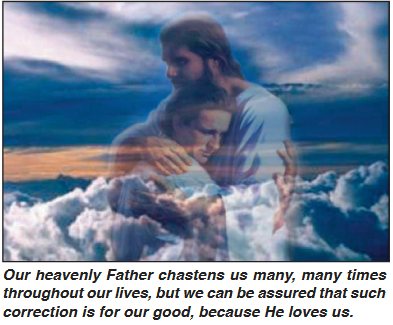 God’s great love for us leads Him to discipline us in ways unique to each of us, so we will forsake our sins and weakness and gain God’s stature. Look at Paul’s having to endure a “thorn in the flesh,” which he pleaded for God to take away three times. It became clear to Paul that this “thorn” was to prevent him from being “exalted above measure” (II Corinthians 12:7). That phrase, from the Greek huperairomai, means “to raise oneself over, i.e., to become haughty.” God knew that Paul had a weakness of potentially bragging about the many revelations he had experienced from God, so He gave Paul a “messenger of Satan” to pester him to keep him humble. He also told Paul, “My grace is sufficient for you, for My strength is made perfect in weakness” (II Corinthians 12:9).
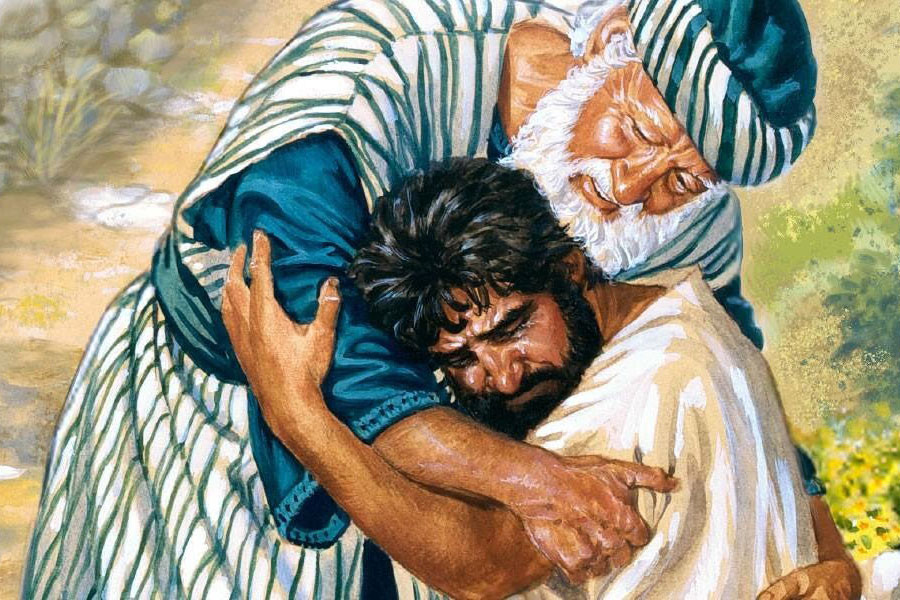
Our heavenly Father shows His love for us even through sufferings and trials He places upon us! We must accept those trials, even rejoice in them (James 1:2). If we have strayed from His ways we can repent, and like the prodigal son turn back from squandering our inheritance and feast with our Father in heaven when He hugs us and forgives us on our return.
To Become Just Like Him!
The Father’s ultimate goal for each one of us is to become like Him! We are, after all, made in His image [tselem], the express likenes of Elohim. That word tselem signifies a replica (I Samuel 6:5), and in Genesis 5:3 the same word refers to Seth being made in the very likeness of his father Adam. The father and the son have the same appearance, internal qualities, and ultimate potential.
That potential to become just like the Father should in no wise be thought impossible, but rather be seen as the very purpose for which He made us: to multiply the love and joy inherent in Him. God is love! (I John 4:8). If Jesus told Philip the night He was betrayed, “He who has seen Me has seen the Father …” (John 14:9), this statement must refer to a likeness of Jesus to the Father in all respects: body, mind, and spirit. How else can we understand the statements Christ made later in this discourse when He stated:
“… that they all may be one, as You [the Father], are in Me, and I in You, that they also may be one in Us, that the world may believe that You sent Me And the glory which You gave Me I have given them, that they may be one just as We are one: I in them, and You in Me; that they may be made perfect in one …” (John 17:21-23).
Being “one” with the Father and Christ goes to the very core of our future existence, not just the DNA we inherited from Adam for our physical existence, but one might say our “spiritual DNA” as well — what makes up the total person. After all, we are brothers of Jesus Christ in every respect, He being “… the firstborn among many brethren” (Romans 8:29).
“… being transformed into the image [of the Father] from glory to glory …” (II Corinthians 3:18).
“… who [Christ] will transform our lowly body that it may be conformed to His glorious body …” (Philippians 3:21).
“… and it has not yet been revealed what we shall be, but we know that when He is revealed, we shall be like Him, for we shall see Him as He is [in His glorified form]” (I John 3:2).
Even as Jesus Christ is the son of God (Matthew 14:33; etc), we are likewise sons of God (Romans 8:14, 19; Galatians 4:6; Philippians 2:15; Hebrews 12:7; I John 3:1-2; Revelation 21:7). Like Father — like son. The love of the Father will grant His sons to be like Him.
One of history’s greatest scientists, Johannes Kepler, in the 17th Century concluded that the creation — which true science stives to understand and codify — is governed by God’s laws, and:
“Those laws [of nature] are within the grasp of the human mind; God wanted us to recognize them by creating us after His own image so that we could share in His own thoughts.”
Yes indeed, we are made to share in His own thoughts so that we can become like Him! Could it be that Isaiah in chapter 9, verse 6, when he is prophesied to be called “Wonderful, Counselor, Mighty God, Prince of Peace,” was also to be called “Everlasting Father” because He was (is) destined to become a Father Himself in the progression of family growth … even as a son eventually in due course becomes a father? That is the pattern of the creation. Sons become fathers. Why not then in the spiritual consequence of time?
Our heavenly Father has a boundless love for us, and will not relent in guiding us along the pathways of righteousness to His awesome throne, a throne beside which we are destined to reside along with Jesus Christ (Revelation 3:21). With that future in mind, how can any of us shy back from the awesome calling God has given us?
Our Heavenly Father Will Never Leave Us!
Let this paper end with a revisitation to the parable of the prodigal son. Is this story not a direct reference to our personal relationship with our heavenly Father? Notice what this parable says.
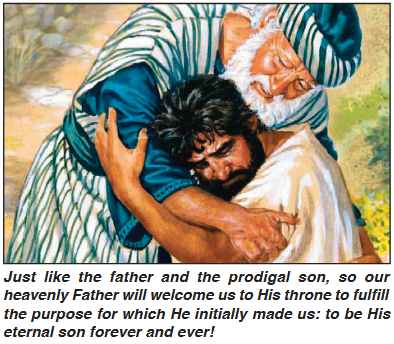 “Then Jesus said, There was a man who had two sons. The younger son said to him, ‘Father, give me my share of the estate.’ So he divided his property between them. After a few days, the younger son got everything together and journeyed to a distant country, where he squandered his wealth in wild living. After he had spent all he had, a severe famine swept through that country, and he began to be in need. So he went and hired himself out to a citizen of that country, who sent him into his fields to feed the pigs. He longed to fill his belly with the pods the pigs were eating, but no one would give him a thing. Finally he came to his senses and said, ‘How many of my father’s hired servants have plenty of food, but here I am, starving to death! I will get up and go back to my father and say to him, “Father, I have sinned against heaven and against you. I am no longer worthy to be called your son. Make me like one of your hired servants.” So he got up and went to his father. But while he was still in the distance, his father saw him and was filled with compassion. He ran to his son, embraced him, and kissed him. The son declared, ‘Father, I have sinned against heaven and against you. I am no longer worthy to be called your son.’ But the father said to his servants, ‘Quick! Bring the best robe and put it on him. Put a ring on his finger and sandals on his feet. Bring the fattened calf and kill it. Let us feast and celebrate. For this son of mine was dead and is alive again! He was lost and is found!’ So they began to celebrate. Meanwhile the older son was in the field, and as he approached the house, he heard music and dancing. So he called one of the servants and asked what was going on. ‘Your brother has returned,’ he said, ‘and your father has killed the fattened calf, because he has him back safe and sound.’ The older son became angry and refused to go in. So his father came out and pleaded with him. But he answered his father, ‘Look, all these years I have served you and never disobeyed a commandment of yours. Yet you never gave me even a young goat so I could celebrate with my friends. But when this son of yours returns from squandering your wealth with prostitutes, you kill the fattened calf for him!’ ‘Son, you are always with me,’ the father said, ‘and all that is mine is yours. But it was fitting to celebrate and be glad, because this brother of yours was dead and is alive again; he was lost and is found’ ” (Luke 15:11-32).
The father was looking for him, probably having his eyes trained towards the road he thought he would return on much of the time. HE YEARNED FOR HIS SON TO RETURN TO HIM, FOR HE LOVED HIM BEYOND WHAT WORDS CAN EXPRESS. That is how our heavenly Father thinks of us. He yearns for us to be close to Him, that He may hug us and wipe away our tears after our sojourn as flesh and blood on this war-torn earth.
Our Father says, “Let your conduct be without covetousness; be content with such things as you have. For He Himself has said, ‘I will never leave you nor forsake you’” Hebrews 13:5). He is always more than ready to accept us and welcome us into his eternal mansions. Yes, we must obey Him, but in His love He forgives and brings us back to Him when we stray. It is His promise — if we do not give up along the way (Galatians 6:9).