


Reject the Norms of a Darkened World!
We Must Swim Upstream Against the Growing Cascade of Evil
We live during a time in history that is unprecedented this side of the great flood, similar to the time before the flood when “… the Lord saw that the wickedness of man was great in the earth, and that every intent of the thoughts of his heart was only evil continually” (Genesis 6:5). End-time society will be similar to this pre-flood world, for Jesus declared, “But as in the days of Noah were, so also will be the coming of the Son of Man be. For as in the days before the flood, they were eating and drinking, marrying and giving in marriage, until the day that Noah entered the ark” (Matthew 24:37-38).
Satan and his cadre are doing all they can to corrupt the earth today, as they have ever since man was put in the Garden of Eden about 6,000 years ago, for he is the god of this world (Matthew 4:8-9; II Corinthians 4:4; Ephesians 2:2), and he is zealous to exterminate those made in God’s image, who are destined to replace him as rulers on the earth (Revelation 5:10; 20:4). As we near the end of the age, the return of Jesus Christ, and the resurrection it appears that the Devil is working overtime to try and upset the illustrious plans of the Eternal.
 We are being bombarded by teachings of news networks, school instructors, advertising, and even religious institutions that good is evil, and evil is good:
“Woe to those who call evil good, and good evil, [or ‘concerning evil, it is good’]; who put darkness for light, and light for darkness; who put bitter for sweet, and sweet for bitter!” (Isaiah 5:20).
People make God into their own image in an attempt to justify their evil works, even believing that worshipping idols is fine, that their choice of the pathway that leads to death is entirely acceptable. Some even believe they will have blessings poured out upon them by following the ways of the heathen.
“It is not with you alone that I am making this covenant and this oath, but with those [future Israelites] who are not here with us today, as well as with those who stand here with us today in the presence of the Lord our God (for you know how we lived in the land of Egypt, and how we passed through the nations along the way; and you have seen their detestable acts and their [repulsive] idols of wood and stone, [lifeless images] of silver and gold, which they had with them), so that there will not be among you a man or woman, or family or tribe, whose heart turns away today from the LORD our God, to go and serve the [false] gods of these nations; so that there will not be among you a root [of idolatry] bearing poisonous fruit and wormwood [bitterness]. It will happen that when he [a renegade] hears the words of this oath, and he imagines himself as blessed, saying. ‘I will have peace and safety even though I walk within the stubbornness of my heart [rejecting God and His law], in order that the watered land dwindles away along with the dry [destroying everything]’ …” (Deuteronomy 29:14-19, Amplified Bible).
These Israelites actually believed that the agreement Yahweh made with them was one-sided, that they could determine what was right or wrong, and God would bless them no matter what they did. Do we not have people who believe that way today, who have been convinced that they themselves can determine truth and fiction irrespective of God’s perfect wisdom?
Indeed we do! They are present all around us, people who “… speak evil of the things they do not understand … carousing in their own deception … having eyes full of adultery and that cannot cease from sin …” (II Peter 2:12-14). As the Scripture makes clear in Deuteronomy 29:20-21, Yahweh will not forgive them, but His anger and jealousy will burn against them, “and every curse which is written in this book will rest on him; the Lord will blot out his name from under heaven. Then the Lord will single him out for disaster …” as stated in the Book of the Law.
The Spiritual Battle We Fight
We must not be our own god and determine what is right and wrong, but look to the one true God who made each of us, and gave us laws of living to follow, laws that grant us blessings of every kind if we follow them. Let us look at some of the issues that we must confront in today’s world which so many people have been deceived to accept.
1. We are coerced to fear men rather than God.
The world’s way
 Adolph Hitler. “Terrorism is the best political weapon, for nothing drives people than a fear of sudden death.” “ Being duly better informed about their knowledge than my adversaries themselves, I argued till finally one day they applied the one means that wins the easiest victory over reason: terror and force.”
Herbert Hoover. “ Why of course the people don’t want war. Why should some poor slob on a farm want to risk his life in a war when the best he can get out of it is to come back to his farm in one piece? Naturally the common people don’t want war neither in Russia, nor in England, nor for that matter in Germany. That is understood. But after all, it is the leaders of the country who determine the policy and it is always a simple matter to drag the people along, whether it is a democracy, or a fascist dictatorship, or a parliament, or a communist dictatorship. Voice or no voice, the people can always be brought to a bidding of the leaders. That is easy. All you have to do is tell them they are being attacked, and denounce the peacemakers for lack of patriotism and exposing the country to danger. It works the same in any country.”
Winston Churchill. “You see these dictators on their pedestals, surrounded by the bayonets of their soldiers and the truncheons of their police. Yet in their hearts there is unspoken — unspeakable — fear. They are afraid of words and thoughts! Words spoken abroad, thoughts stirring at home, all the more powerful because they are forbidden. These terrify them. A little mouse — a little tiny mouse! — of thought appears in the room, and even the mightiest potentates are thrown into panic.”
Douglas MacArthur. “Our government has kept us in a continuous stampede of patriotic fervor — with the cry of grave national emergency. Always, there has been some terrible evil at home , or some monstrous foreign power that has been going to gobble us up if we did not blindly rally behind it by furnishing the exorbitant sums demanded. Yet, in retrospect, these disasters seem never to have happened, seem never to have been quite real.”
Friedrich Nietzsche. “The governments of the great States have two instruments for keeping people dependent, in fear and obedience: a coarser, the army; and a more refined, the school.”
Henry David Thoreau. “Government is not reason, it is not eloquence — it is force. Like fire, it is a dangerous servant and fearful master.”
George Washington. “When the people fear the government, there is tyranny. When the government fears to people, there is liberty.”
God’s way
The word of God is clear regarding the fear of men: do not fear men, but fear God!
“Do not put your trust in princes, nor in a son of man, in whom there is no help. His spirit departs, he returns to his earth; in that very day his plans perish” (Psalm 146:3-4; see also Psalm 22:23; 25:14; 27:1-3).
“Do not let your heart envy sinners, but be zealous for the fear of the Lord every day” (Proverbs 23:17).
“The fear of man brings a snare, but whoever trusts in the Lord shall be safe” (Proverbs 29:25; see also Proverbs 1:7; 14:26-27).
“Inasmuch then as the children have partaken of flesh and blood, He Himself likewise shared in the same, that through death He might destroy him who had the power of death, that is, the devil, and release those who through fear of death were all their lifetime subject to bondage” (Hebrews 2:14-15).
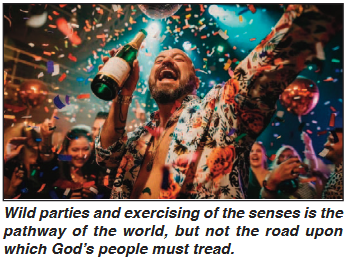 2. We are encouraged to do what feels good rather than what is right.
The world’s way
There is nothing wrong with feeling good — in fact, the abundant life grants good feelings and emotions to us — but we are speaking here of efforts of titillate and exaggerate the normal built-in emotional responses designed to be experienced when we live righteous, law-abiding lives in service to the Creator and to our fellow man. The Apostle Paul makes clear these many “fruits of the flesh” that are expressed apart from the indwelling spirit of God:
“Now the works of the flesh are evident, which are adultery, fornication, uncleanness, lewdness, idolatry, sorcery, hatred, contentions, jealousies, outbursts of wrath, selfish ambitions, dissensions, heresies, envy, murders, drunkenness, revelries, and the like …” (Galatians 5:19-21; see also Romans 1:28-32).
We see all around us the encouragement of such behaviors, such as the great outpouring of contentions and lust on the internet and social media, pornography exploding, hatred and violence with nations fomenting war against adversaries, advertising which builds on envy to purchase products, astrology and fortune tellers promising wealth and prosperity, and the list goes on. Satan’s character infects people at every level if they allow him to fuel these unhealthy thoughts. Love for the Creator and one’s neighbor is suppressed by craving to satisfy one’s own excitement. Personal satisfaction becomes the norm for these misled people, like the Israelites at Mt. Sinai who worshipped the golden calf and “… sat down to eat and drink, and rose up to play [tsachaz, ‘to laugh in merriment, to sport’]” (Exodus 32:6).
God’s way
The Apostle Paul placed this issue of self-indulgence clearly in its place:
“Therefore I run thus: not with uncertainty. Thus I fight: not as one who beats the air. But I discipline my body and bring it into subjection, lest, when I have preached to others, I myself should become disqualified” (I Corinthians 9:26-27).
Paul recognized his weaknesses in the flesh, but also thoroughly understood that keeping the laws of God in the spirit overcame those weaknesses (Romans 7:18-25). He spoke of presenting one’s members as “… slaves of righteousness for holiness” (Romans 6:19), and “… if by the spirit you put to death the deeds of the body, you will live” (Romans 8:13). Instead, these exercises of titillating one’s fleshly lusts are to be replaced by “… tender mercies, kindness, humility, meekness, longsuffering; bearing with one another, and forgiving one another …” (Colossians 3:12-13).
“Therefore, since Christ suffered for us in the flesh, arm yourselves also with the same mind, for he who has suffered in the flesh has ceased from sin, that he no longer should live the rest of his time in the flesh for the lusts of men, but for the will of God. For we have spent enough of our past lifetime in doing the will of the Gentiles — when we walked in lewdness, lusts, drunkenness, revelries, drinking parties, and abominable idolatries. In regard to these, they think it strange that you do not run with them in the same flood of dissipation, speaking evil of you. They will give an account to Him who is ready to judge the living and the dead” (I Peter 4:1-5).
We are to live by the spirit of God, which fruits are love, joy, peace, longsuffering, kindness, goodness, faithfulness, gentleness, and self control (Galatians 5:22-23). We are to be a spectacle [theatron, “a place for public show, a general audience, a show or theater”] to the world, who “… as sojourners and pilgrims, abstain from fleshly lusts which war against the soul, having your conduct honorable among the gentiles, that when they speak against you as evildoers, they may, by your good works which they observe, glorify God in the day of visitation” (I Peter 2:11-12).
The Torah spells out special blessings to those who follow the Eternal’s footsteps. For example:
“Now therefore, if you will indeed obey My voice and keep my covenant, then you shall be a special treasure to Me above all people; for all the earth is Mine” (Exodus 19:5).
“For you are a holy people to the Lord your God, and the Lord has chosen you to be a people for Himself, a special treasure above all the peoples who are on the face of the earth” (Deuteronomy 14:2; see also 26:18).
“For the Lord has chosen Jacob for Himself, Israel for His special treasure “ (Psalm 135:4).
We are appropriated out of the world’s evil system by the Eternal to be these special people, having been redeemed from lawless deeds, purified to be His own special people, zealous for good works (Titus 2:14), not to strive after whatever feels good to our fleshly bodies. We are to serve the ever-living God!
3. We are encouraged to dish out to others what evil they have dished out to us — kind for kind.
The world’s way
Throughout mankind’s history the usual response of people and nations has been to do unto others whatever evil has been done unto them. As a result, we see revenge being sought by people, communities, and nations all across the world. One of the most noted family feuds was that of the Hatfields and McCoys along the border of West Virginia and Kentucky (www.encyclopediabritannica.com).
The Hatfields and McCoys
 The origins of the feud are obscure. Some attribute it to hostilities formed during the American Civil War, in which the McCoys were Unionists and the Hatfields were Confederates, others to Rand’l McCoy’s belief that a Hatfield stole one of his hogs in 1878. The first major bloodletting did not occur until 1882, when Ellison Hatfield was mortally shot in a brawl with McCoys and, in revenge, the Hatfields kidnapped and executed three McCoy brothers. Thereafter, Hatfields and McCoys repeatedly ambushed and killed one another. On New Year’s Day in 1888, a group of Hatfields led by Jim Vance attacked the home of Patriarch Rand’l McCoy, missing him but shooting dead a son and a daughter and burning his houses. In retaliation, a posse of McCoys and neighbors, headed by a Pike county deputy sheriff, made successive raids across the border into West Virginia, killing Vance and at least three others, battling with a West Virginia posse, and eventually rounding up nine of the Hatfield clan for indictment and trial in Kentucky. West Virginia filed suit in federal court, charging kidnapping and lawlessness. In May 1888, a divided U.S. Supreme Court ruled that Kentucky had the legal right to detain the accused for trial. The trials, later in the year, resulted in one sentence of death by hanging and eight sentences of imprisonment. Although there were flare-ups thereafter, the feuding gradually abated and had ended by the second decade of the 20th century.
Nation Versus Nation
Many national conflicts have arisen over the centuries due to revenge and spite. Take for instance the long-standing conflict of the Ottomans and the Persians (1500s-1820s).
The Ottoman Empire was located in the middle of Eurasia and straddled some of the most important straits in the world. Persia was the Ottoman Empire’s next door neighbor to the east, and had a long history of its own. Today, these old empires have cultural cores in Turkey and Iran, two of the most important actors in the volatile Middle East. While the Ottoman Empire remained relatively stable, the Persians went through four dynasties during their centuries-long struggle with the Ottomans: the Safavids (1501-1736), the Afsharids (1736-1796), the Zands (1751-1794), and the Qajars (1789-1925). Both empires struggled for supremacy over each other for a variety of reasons, if nothing else to gain notoriety for the current ruling despot.
 Then we have the Comanche versus everybody (1700-1900). The Comanche fought everybody that dared to cross them. They were hated by the Utes and the Apache and feared by the Cheyenne and Kiowa. The comanche fought Mexico, the United States, Texas, and France. In New Mexico and among the Sioux and the Pawnee, the Comanche were loathed. The Comanche were so powerful that they forced Texas, Mexico, and the United States to the negotiating table on numerous occasions, and Sam Houston repeatedly tried to hammer out a stable peace with them. The California Gold Rush devastated Commancheria in the 1850’s, but by the 1860s and 70s the Comanche were thriving again, this time making life difficult for the likes of Kit Carson and William Tecumseh Sherman, architect of the total war strategy that devastated and demoralized the confederacy during the Civil War. Both men barely escaped with their lives while trying to pacify Comancheria. In the end, a combination of heavy warfare, disease, ecological degradation (in the form of declining buffalo populations), and the growing ease of sedentary life led to the end of Comanche rivalries.
Actually, the Mosaic laws of ancient Israel had a flavor of revenge embedded with them. Note Exodus 21:23-25: “But if any harm follows [a fight between two men], then you shall give life for life, eye for eye, tooth for tooth, hand for hand, foot for foot, burn for burn, wound for wound, stripe for stripe” (see also Leviticus 24:20 and Deuteronomy 19:21). Also, cities of refuge were designated to which someone who killed a person accidentially could flee and be safe, avoiding being killed by an avenger of blood who would track him down to kill him (Numbers 35:6-34).
God’s way
The course of action a believer must take is drastically opposed to that of the world. God’s people are to do good in the face of evil.
“Bless those who persecute you; bless and do not curse … Repay no one evil for evil. Have regard for good things in the sight of all men. If it is possible, as much as depends on you, live peaceably with all men. Beloved, do not avenge yourselves, but rather give place to wrath; for it is written, ‘Vengeance is Mine, I will repay,’ says the Lord. Therefore, ‘If your enemy is hungry, feed him; if he is thirsty give him drink; for in so doing you will heap coals of fire on his head.’ Do not be overcome by evil, but overcome evil with good” (Romans 12:14, 17-21).
Rather than “an eye for an eye and a tooth for a tooth” God’s people are told to not resist an evil person; if someone slaps you on your right cheek, turn to him the other cheek. We are to love our enemies, bless and not curse them, do good to those who hate you, and pray for those who spitefully use you and persecute you (Matthew 5:38-48). Revenge has no place in the heart of God’s people. Like Jesus, even when He was hanging on the stake, we must say, “Father, forgive them, for they know not what they do” (Luke 23:34).
4. We are told that being depressed at times is not normal, and should be treated with drugs.
The World’s way
The standard antidote prescribed by physicians for serious depression and hopelessness is to take a drug, such as Prozac and Zoloft. There are limited efforts to encourage victims to change their thought patterns and health habits such as diet, exercise, sunshine, and fresh air. Few physicians would ever consider telling their patients to seek after God and His will, even though that is the ultimate solution to their troubles.
God’s way
Our heavenly Father shows us there is a purpose for depression, or lowliness of mind and heart, for without such an attitude a person cannot draw close to almighty God.
 “Though the Lord is on high, yet He regards the lowly [shaphel, ‘depressed’]; but the proud He knows from afar” (Psalm 138:6).
“Surely He scorns the scornful, but gives grace to the humble [anav, ‘depressed, in mind or circumstances’]” (Proverbs 3:34).
“Rejoice greatly, O daughter of Zion! Shout, O daughter of Jerusalem! Behold your King is coming to you; He is just and having salvation, lowly [aniy, ‘depressed, in mind of circumstances’] and riding on a donkey, a colt, the foal of a donkey” (Zechariah 9:9). The root word of aniy is anah, through the idea of looking down or browbeating, or to depress.
“Take My yoke upon you and learn from Me, for I am gentle and lowly [tapeinos, ‘depressed, humiliated in circumstances or disposition’] in heart, and you wil find rest for your souls, for My yoke is easy and My burden is light” (Matthew 11:29-30).
“‘For all these things My hand has made, and all these things exist.’ says the Lord. ‘But on this one will I look: on him who is poor [aniy] and of a contrite [nakeh, ‘smitten, maimed, dejected’] spirit, and who trembles at My word’” (Isaiah 66:2).
Being depressed, or humble, in spirit is shown to be well-pleasing to our Creator, and essential for our drawing close to Him. Our great God rejects those who are proud in spirit, who think of themselves as being great. He distances himself from these people, but draws near to and hears those who do not think of themselves as being great, but defer to their Creator and strive to please Him — to do His will. See James 4:6-10, where it is clear that by submitting to God in humility one is able to resist the wiles of the Devil, who will then flee from you. By humbling yourself before God, He will lift you up!
“Lament and mourn and weep! Let your laughter be turned to mourning and your joy to gloom. Humble [tapeinos] yourselves in the sight of the Lord, and He will lift you up” (James 4:9-10).
5. Get rich in material goods to become great.
The world’s way
Those that are considered great in the world, who capture headlines and who are praised by the media and exalted by so many, are usually wealthy. “Success” is so often defined in terms of one’s power exerted through the use of money and wealth. Corporate executives, political leaders, sports standouts, wise investors, and others amass sometimes billions of dollars in their portfolios. With such material wealth, many of these people invest in efforts of influence the destiny of people and entire nations. Bank accounts and material things become idols that are worshipped. Yet, these wealthy, materialistic people seldom have peace of mind and unfettered joy in living, since their attention is focused on protecting their wealth and increasing it.
 “Do not be afraid when one becomes rich, when the glory of his house is increased; for when he dies he shall carry nothing away; his glory shall not descend after him. Though while he lives he blesses himself (for men will praise you when you do well for yourself), he shall go to the generation of his fathers; they shall never see light” (Psalm 49:16-19; see also Psalm 52:7; 62:10; 73:12; Proverbs 11:4, 28; 18:11; 22:1, 7; 23:4-5; 28:22).
“He who loves money is never satisfied by money, and he who loves wealth is never satisfied by income. This too is futile. When good things increase, so do those who consume them; what then is the profit to the owner, except to behold them with his eyes? The sleep of the worker is sweet, whether he eats little or much, but the abundance of the rich man permits him no sleep. (Ecclesiastes 5:10-12, Berean Standard Bible).
“Now godliness with contentment is great gain. For we brought nothing into this world, and it is certain we can carry nothing out. And having food and clothing, with these we shall be content. But those who desire to be rich fall into temptation and a snare, and into many foolish and harmful lusts which drown men in destruction and perdition. For the love of money is the root of all kinds of evil, for which some have strayed from the faith in their greediness, and pierced themselves through with many sorrows” (I Timothy 6:6-10).
“Come now, you rich, weep and howl for your miseries that are coming upon you! Your riches are corrupted, and your garments are motheaten. Your gold and silver are corroded, and their corrosion will be a witness against you and will eat your flesh like fire. You have heaped up treasure in the last days. Indeed the wages of the laborers who mowed your fields, which you kept back by fraud, cry out; and the cries of the reapers have reached the ears of the Lord of Sabaoth. You have lived on the earth in pleasure and luxury; you have fattened your hearts as in a day of slaughter. You have condemned, you have murdered “ (James 5: 1-6).
God’s way
Our great God draws close to the poor and contrite spirit, and usually that attitude is found in the materially poor people of the world.
“Happy, in spirit, are the poor, for theirs is the kingdom of the heavens” (Matthew 5:3, Concordant Version). The NEB Version puts it this way: “How blest are those who know that they are poor ….” The Phillips Translation states, “How happy are the humble-minded….”
Being poor in physical wealth draws one close to God through humility: such people oftentimes have nowhere to turn but to their Creator. On the other hand, some who have wealth, like our forefather Abraham, was very wealthy in gold, silver, livestock, servants, and other things but was very humble, so much so that he qualified as the “father of the faithful.” He put the Eternal above everything else in his life (Genesis 13:2; Galatians 3:9; Hebrews 11:8-11).
Rather than striving after riches and material goods, the elect are told to work hard at whatever they do (Ecclesiastes 9:10), and enjoy wealth if it comes (Proverbs 3:9-10), but become rich in spiritual matters above all else. You cannot serve both God and money (Matthew 6:24). Physical wealth can never truly satisfy the longings of the heart.
“Do not wear yourself out ot get rich; be wise enough to restrain yourself. When you glance at wealth, it disappears, for it makes wings for itself and flies like an eagle to the sky” (Proverbs 23:4-5, Berean Standard Bible).
“There is one who makes himself rich, yet has nothing; and one who makes himself poor, yet has great riches” (Proverbs 13:7).
“A good name is to be chosen rather than great riches, loving favor rather than silver and gold” (Proverbs 22:1).
“Do not store up for yourselves treasures on earth, where moth and rust destroy, and where thieves break in and steal. But store up for yourselves treasures in heaven, where moth and rust do not destroy, and where thieves do not break in and steal. For where your treasure is, there your heart will be also: (Matthew 6:19-21, Berean Standard Bible).
“Instruct those who are rich in the present age not to be conceited and not to put their hope in the uncertainty of wealth, but in God, who richly provides all things for us to enjoy. Instruct them to do good, to be rich in good works, and to be generous and ready to share, treasuring up for themselves a firm foundation for the future, so that they may take hold of that which is truly life” (I Timothy 6:17-19, Berean Standard Bible).
“And He said to them, ‘Watch out! Guard yourselves against every form of greed, for one’s life does not consist in the abundance of his possessions.’ Then He told them a parable: ‘The ground of a certain rich man produced an abundance. So he thought to himself, ‘What shall I do, since I have nowhere to store my crops …?’” (Luke 12:16-21, Berean Standard Bible).
The farmer who reaped such abundant crops was very foolish, for he relied on his wealth to sustain him, to take life easy, eat, drink, and be merry. Physical wealth can be a trap if it causes you to stop moving forward in the faith, and fail to follow the admonitions of Paul, when he says we must press forward toward the goal of our calling, and forget what is behind (Philippians 3:12-14). We should be content with food and clothing, for those who desire to be rich fall into temptations, snares, and lusts that lead to much trouble” (I Timothy 6:8-9).
6. We should go into debt to get what we want.
The World’s way
This point is a close corollary to point 5, but a very important one to address. Merchants of every quarter strive to sell you something, be it new car, expensive clothing, jewelry, Dr. Pepper, or a new computer. The issue is not whether or not you actually need the item or service, but how these merchants can convince you to buy what they have — to part with your money
 The debt spiral in the United States is entirely out of hand. Personal debt is estimated to be $18.3 trillion, including credit cards, mortgages, auto loans, and student loans, or about $105,000 per consumer. Meanwhile, the federal government debt is $38.4 trillion, which increases $6.12 billion per day This incredible debt load is adding nothing but misery to the multiple millions of people carrying the debt, for as Solomon stated:
“The rich rules over the poor, and the borrower is servant of the leader “ (Proverbs 22:7).
Thus, the very reality of debt abrogates proper governmental associations amongst people, placing the lender over the borrower in a hierarchical fashion. This association runs utterly contrary to the relationship the Creator designed for mankind, whereby each person is to “… let each esteem others better than himself” (Philippians 2:3), and “Be kindly affectionate to one another with brotherly love, in honor giving preference to one another” (Romans 12:10). In fact, Jesus is called the “firstborn among many brethren” — not our “elder overlord” — in Roman 8:29, and the fact that Jesus washed the disciples’ feet shows us the humble, servant relationship we are to have with one another. We are to “Owe no one anything except to love one another, for he who loves another has fulfilled the law” (Romans 13:8).
The very concept of debt transgresses the commands to love the Eternal with all of our heart, soul, and mind, and our neighbor as ourselves (Matthew 22:37-39), upon which the entire Law and Prophets rest (verse 40). Thus, we can understand why Jesus said we should ”… love your enemies, do good, and lend, hoping for nothing in return, and your reward will be great, and you will be sons of the Most High” (Luke 6:35).
God’s way
The Scriptures above have already covered God’s answer to the debt question: we should have only the debt of love to owe one another (Romans 13:8). The “Lords Prayer” itself commands us to forgive our debtors, even as we ask the Eternal to forgive us of our debts [opheilema, “something owed”] (Matthew 6:12). Physical debts are paralleled with sins or trespasses [paraptoma, “side-slip, lapse, unintentional or willful trespasses”] in this model prayer, and unless we forgive others of their trespass against us the Father will not forgive our mishaps — showing just how serious a matter forgiving physical debts is.
The key point here is that we should be out of debt if at all possible so as not to be the servant of any lender — another person or agency — to avoid having some other person be a master over us. Our only Master must be God Himself. Thus, it is clear that Satan, who wants to subject all of mankind to his authority, wants to burden everyone with debt — the more the better. In response to the Adversary’s evil system, Yahweh invoked debt forgiveness directly into His nation’s economic system:
“At the end of every seven years [the shemitah year] you shall grant a release [shamet, ‘to release, to let drop, to let go’] of debts. And this is the form of the release: Every creditor who has lent anything to his neighbor shall release it; he shall not require it of his neighbor or his brother, because it is called the Lord’s release” (Deuteronomy 15:2-3).
In addition, land was never to leave the possession of a family it had been allotted to, so every 50 years a Jubilee Year occurred, wherein land that had been sold to another farmer had to be returned free of charge (Leviticus 25:9-10). Debt is not a state of economic servitude the Eternal ever desired for mankind. Everyone in debt should have a plan to get out of debt; it is not always easy, but well worth the effort in terms of peace of mind and the ability to operate more effectively in life. As Paul warned thieves:
“Let him who stole steal no longer, but rather let him labor, working with his hand what is good, that he may have something to give him who has need” (Ephesians 4:28).
The Battle Against the Flow
The flow of the world around us wants to drag us along, but like a salmon heading upstream against the flow towards its spawing ground, we must fight our way upstream, toward the headwaters of the heavenly Zion, the very thone of God! That battle can be difficult, even exhausting, but the effort is worth very ounce of strength we exert.
I love the admonition that Paul gives in Hebrews 12:1-4:
“Therefore we also, since we are surrounded by so great a cloud of witnesses, let us lay aside every weight, and the sin which so easily ensnares us, and let us run with endurance the race that is set before us, looking unto Jesus, the author and finisher of our faith, who for the joy that was set before Him endured the cross, despising the shame, and has sat down at the right hand of the throne of God. For consider Him who endured such hostility from sinners against Himself, lest you become weary and discouraged in your souls. You have not yet resisted to bloodshed, striving against sin.”
We may have to someday “resist to bloodshed,” but even may have to endure beatings, imprisonment, false accusations, and even death during the coming months and years as we await the return of Jesus Christ at the resurrection. We have been warned that such trials will face us, but we are also given the assurance that through the trials we will overcome through the power of the spirit within us. We have been crucified with Christ, and He now lives within us (Galatians 2:20)!
Moreover, we have been given the tools to overcome the Adversary by resisting him, “… steadfast in the faith, knowing that the same sufferings are experienced by your brotherhood in the world” (I Peter 5:9). Here is the armor of our great God to enable us to withstand any evil that may strike us (Ephesians 4:11, 14-17):
Your waist girded with truth
Having the breastplate of righteousness
Your feet having the good news of the kingdom
Taking the shield of faith
Putting on the helmet of salvation
Wielding the sword of God’s word
With these tools we can reject the norms of this darkened world. The world will hate us, even as it hated Jesus when He walked the earth, for He was not a part of this world’s society any more than we are to be (John 15:18).
“… do not be conformed to this world [aion, ‘age, the world’], but be transformed by the renewing of your mind, that you may prove what is that good and acceptable and perfect will of God” (Romans 12:2).