


Repentance: An Essential Step for Eternal Life
Without It You Have No Future!
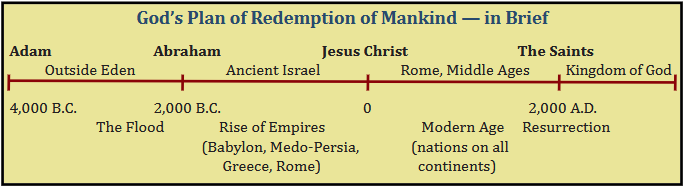
We live in a world ordered by Satan the Devil, with sin encompassing every aspect of our lives. He has deceived the whole world (Revelation 12:9), and is the father of lies, the great deceiver, a murderer, and a thief, the corrupt spirit being who once was perfect at the very throne of God (Ezekiel 28:14). Then he sinned through merchandising, placing the entire earth on a buying and selling footing for the very survival of people in all nations (Ezekiel 28:15-18). In his audacious pride he even offered Jesus possession of the nations of the world (Matthew 4:8-9).
With sin came death. The Devil tempted Adam and Eve in the garden of Eden, and they took of the forbidden fruit of the tree of the knowledge of good and evil, resulting in the fulfillment of God’s threat, “… for in the day that you eat of it you shall surely die” (Genesis 2:17; Romans 6:23). Such a traumatic event has consigned every single human being to death ever since Eden, “… for all have sinned and fall short of the glory of God” (Romans 3:23; Galatians 3:22).
In His mercy and love for humankind made in His very express image, He began the process of reconciliation toward sinful mankind through Abram — later renamed Abraham — who received promises of land, greatness, myriads of descendants, an everlasting covenant, and ultimately the Savior Jesus who came through the tribe of Judah, the son of God whose sinless life, crucifixion, and resurrection paid the price for the sins of all mankind — for Israel first, but ultimately for all of mankind (Genesis 12:1-3; 15:5; 16:10; 17:1-8 26:3-4). His plan is to ultimately call people of all nations — for He desires that none be lost (II Peter 3:9) — and grant them eternal life, the reality of being sons of God even as Jesus Christ is the son of God (John 6:44; Romans 8:29; I John 3:2).
Repentance — Recovery from Death
Removing sin from one’s life is the key to abundant life in this physical realm, and for eternal life in the spirit. That process is summarized in Hebrews 6:1-2:
“Therefore, leaving the discussion of the elementary principles of Christ, let us go on to perfection, not laying again the foundation of repentance from dead works and of faith toward God, of the doctrine of baptisms, of laying on of hands, or resurrection of the dead, and of eternal judgment.”
The first step in the process of reconciliation toward God is repentance. What does repentance mean? There are three words in the New Testament that are derived from the same root to signify repent, repentance, repented, repentest, and repenteth:
metamellomai (verb), “to regret, to repent; a change in the will which results in change in single individual actions,” translated “to repent.”
metanoeom, ”to perceive afterwards”; meta = after, implying change; noeo = to perceive; in other words, to change one’s mind or purpose, always for the better. The three steps found in metanoeom are:
(1) new knowledge
(2) regret for the previous course and displeasure with the self
(3) a change in action
metanoia (noun), “afterthought, change of mind, repentance,” and is used of repentance from sin or evil (except in Hebrews 12:17; Esau’s birthright rejection could not be reversed), and involves not just turning from sin but turning to God, illustrated in the Parable of the Prodigal Son (Luke 15:11-22).
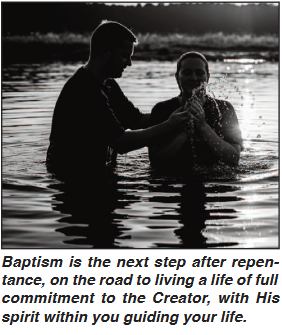 Repentance means change — change from a behavior or thought pattern that is opposed to the laws of God, which is sin (I John 3:4). It means deserting one’s past erroneous ways and following in the footsteps of Jesus Christ (I John 2:6; I Peter 2:21). It is the change in life that Paul so often admonished novice gentile New Testament believers to make.
“Do you not know that the unrighteous will not inherit the kingdom of God? Do not be deceived. Neither fornicators, nor idolaters, nor adulterers, nor homosexuals, nor sodomites, nor thieves, nor covetous, nor drunkards, nor revilers, nor extortioners will inherit the kingdom of God. And such were some of you. But you were washed, but you were sanctified, but you were justified in the name of the Lord Jesus and by the spirit of our God” (I Corinthians 6:9-11).
“Therefore put to death your members which are on the earth: fornication, uncleanness, passion, evil desire, and covetousness, which is idolatry. Because of these things the wrath of God is coming upon the sons of disobedience, in which you yourself once walked when you lived in them” (Colossians 3:5-7).
“And you He made alive, who were dead in trespasses and sins, in which you once walked according to the course of this world, according to the prince of the power of the air, the spirit which now works in the sons of disobedience, among whom also we all once conducted ourselves in the lusts of our flesh, fulfilling the desirers of the flesh and of the mind, and were by nature children of wrath, just as the others” (Ephesians 2:1-3).
You can be sure that sin leads to death, and unless repented of will lead to everlasting destruction. So we read in Ezekiel 18:4 and 20, Romans 6:23, Genesis 2:17, and James 1:15. With this imperative need to repent, what then must we do to repent?
The Process of Repentance
1. Be convicted of your sin. This is prehaps the most painful part of the process, for you must change your behavior and thought processes that have been habitually imprinted into your psyche, oftentimes for years, maybe for all your life. There is no sin without knowledge of the law (Romans 5:13), but when the knowledge of the law is opened to you and you see you have “missed the mark” — which is the meaning of sin [hamartano] — then you must repent, change and leave the error behind, and move forward in newness of life.
The sin may be one of countless forms: fear of man, sexual immorality, outbursts of anger, lewdness, envy, drunkenness, partying, or any of the works of the flesh mentioned in Galatians 5:19-21 and II Timothy 3:1-5. You may even ask God to reveal to you particular sins you may harbor of which you are not even aware. Here is what Job and David had to say about their “secret sins”:
“How many are my iniquities and sins? Make me know my transgression and my sin” (Job 13:23).
“Search me, O God, and know my heart; try me, and know my anxieties; and see if there is any wicked way in me, and lead me in the way everlasting” (Psalm 139:23-24).
2. Be sorrowful for your sin. It is not enough to simply identify a sin you are committing. You must note its seriousness and feel humbled and humiliated by its presence in your life, distressed enough to take action to cast it out of your life. Here is what Paul stated:
“Now I rejoice, not that you were made sorry, but that your sorrow led to repentance. For you were made sorry in a godly manner, that you might suffer loss from us in nothing. For godly sorrow produces repentance leading to salvation, not to be regretted; but the sorrow of the world produces death (II Corinthians 7:9-10).
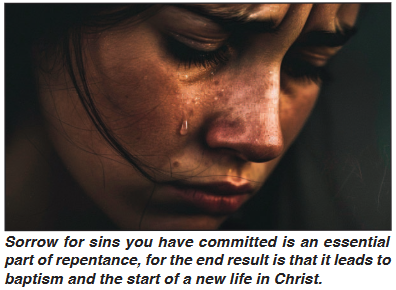 It is heartwarming to realize that when your sorrow for a sin is genuine and deeply felt, the Eternal is all too eager to forgive and cleanse you of the sin. King David committed adultery with Bathsheba and consigned her husband Uriah to death on the battle field. When David was brought face-to-face with the horrible error he had committed — when Nathan the prophet told him of the great transgression and that the sin would be revealed to the whole nation of Israel — David admitted “I have sinned against the Lord” (II Samuel 12:13). While his admission of guilt did not prevent the death of the child conceived in this affair, Nathan told him, “The Lord also has put away your sin; you shall not die.” God forgave even a heinous sin of Israel’s king. He will do likewise for us when we admit our errors and grieve, our sin being a burden we no longer wish to carry. As did King David, we must see our sin as a stench in God’s nostrils and grieve over it … even as Peter “went out and wept bitterly” after denying Jesus the third time (Matthew 27:75).
3. Confess your sin. The apostle John stated this truth perfectly:
“If we confess our sins, He is faithful and just to forgive us our sins and cleanse us from all unrighteousness” (I John 1:9).
James reiterated this need to confess our sins when he wrote, “Confess your trespasses to one another, and pray for one another …” (James 5:16). Sorrow and grief for the sins you have committed must lead you to approach our heavenly Father in humility, to ask for forgiveness of the error — the natural response to our grief. He is ready to forgive!
“Be merciful to me, O Lord, for I cry to you all day long. Rejoice the soul of Your servant, for to You, O Lord, I lift up my soul. For you, Lord, are good, and ready to forgive, and abundant in mercy to all those who call upon You” (Psalm 86:3-5; see also Psalm 130:7; 145:9; Joel 2:13).
It takes true humility to recognize one’s sins, grieve over them, and approach the very throne of the Father to ask for forgiveness:
“But on this one will I look: on him who is poor and of a contrite spirit, and who trembles at My word” (Isaiah 66:2).
4. Turn from your sinful behavior and thoughts. This is perhaps the most difficult part of repentance, for you must crucify your past evil habits and walk in newness of life, free of the sin that has been revealed to you. A habits are hard to break, especially if you have repeated the sin for a long time.
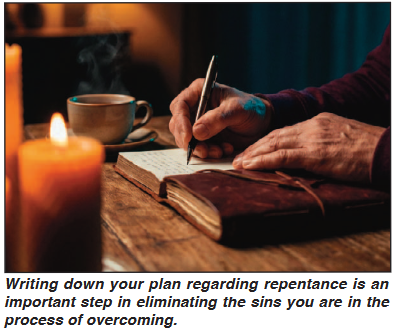 Yet, repentance requires that you stop the evil course and follow the pathway that pleases the Eternal. Maybe you have a habit of criticizing your spouse. You recognize you have made this error for many years, and have come to understand this grievous behavior and confessed your unthankful, unloving attitude to God. Now you must stop being unkind and abrasive to your spouse and instead give encouragement, praise, and honor to him or her. That change may not be easy, but it must be done. It can be done through miraculous divine intervention, instantly or within a few days, or over time by applying rigorous discipline. According to the Cleveland Clinic (How to break bad habits, Health Essentials, www.health.clevelandclinic.org), the path to overcoming bad habits involves one or more of the following points:
(a) Brace yourself for discomfort.
(b) Start making a game plan, and make a journal stating your goal, why you wish to achieve the goal, what triggers the bad habit, what coping skills you have to deal with setbacks, and so forth.
(c) Write down why you want to change, and why you don’t.
(d) Set realistic, incremental goals.
(e) Identify your triggers.
(f) Figure out how to distract yourself; call a friend, take a walk, etc.
(g) Replace bad habits with good ones.
(h) Keep temptation away.
(i) Create incentives, such as doing something positive — like taking a trip — when you reach your goals.
(j) Speak kindly to yourself when you slip up, and resolve to not slip up again.
(k) Remind yourself why you are doing this.
5. Replace your bad habits of thought or deed with Godly ones. You must choose Godliness and holiness every day. The temptation to return to sinful behavior will likely return, so you need to remove the triggers that might cause you to return to your former sin. It may require a change (repentance) in whom you visit, where you travel, who you invite into your home, the music you listen to, the movies or television you watch, or even the job you perform. Do not be like the person whose demon was cast out, and his life was “empty, swept clean, and put in order,” but he did not replace the demonic influence with righteous character. As we read about this parable in Matthew 12:43-46, seven evil spirits came in later to possess this person, whose life was not reformed to fill up the void by the one demon leaving.
 The longer you persist in a new lifestyle, the easier it will become to walk in this new pathway of life. The old habits will be replaced by new ones. It may take at least 10 weeks to break a bad habit, but the time required depends on many factors. The key is to live a holy life each day, renewing your dedication to serve the living God!
“I beseech you therefore, brethren, by the mercies of God, that you present your bodies a living sacrifice, holy, acceptable to God, which is your reasonable service. And do not be conformed to this world, but be transformed by the renewing of your mind, that you may prove what is that good and acceptable and perfect will of God” (Romans 12:1-2).
holy = hagios, “pure, morally blameless, separated from sin and therefore consecrated to God.
“I have been crucified with Christ; it is no longer I who live, but Christ lives in me; and the life which I now live in the flesh I live by faith in the Son of God, who loved me and gave Himself for me” (Galatians 2:20).
Our Examples
Two personalities in Scripture stand out in my mind as wonderful examples of repentance in its fulness: David and Paul.
David. We have already discussed this servant of God to some extent. The entire process of repentance is spelled out by David in Psalm 51, a message in response to his being told of his great sin by Nathan the prophet after his adultery with Bathsheba.
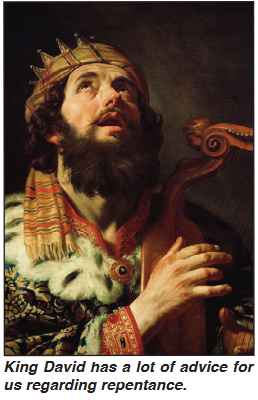 “Have mercy upon me, O God, according to Your lovingkindness: according to the multitude of Your tender mercies, blot out my transgressions, wash me thoroughly from my iniquity, and cleanse me from my sin. For I acknowledge my transgressions, and my sin is always before me. Against You, You only, have I sinned, and done this evil in Your sight — that you may be found just when You speak, and blameless when You judge. Behold I was brought forth in iniquity, and in sin my mother conceived me. Behold, You desire truth in the inward parts, and in the hidden part You will make me to know wisdom. Purge me with hyssop, and I shall be clean; wash me, and I shall be whiter than snow. Make me hear joy and gladness, that the bones You have broken may rejoice. Hide Your face from my sins, and blot out all my iniquities. Create in me a clean heart, O God, and renew a steadfast spirit within me. Do not cast me away from Your presence, and do not take Your Holy Spirit from me. Restore to me the joy of Your salvation, and uphold me by Your generous Spirit. Then I will teach transgressors Your ways, and sinners shall be converted to You. Deliver me from the guilt of bloodshed, O God, the God of my salvation, and my tongue shall sing aloud of Your righteousness. O Lord, open my lips, and my mouth shall show forth Your praise. For You do not desire sacrifice, or else I would give it; You do not delight in burnt offering. The sacrifices of God are a broken spirit, a broken and a contrite heart — these, O God, You will not despise. Do good in Your good pleasure to Zion; build the walls of Jerusalem. Then You shall be pleased with the sacrifices of righteousness, with burnt offering and whole burnt offering; then they shall offer bulls on Your altar.”
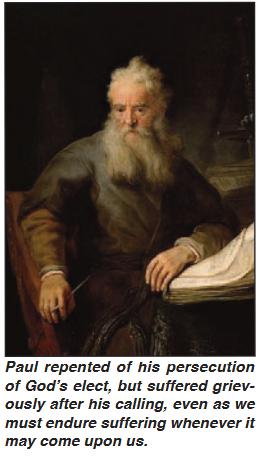 Paul. Paul persecuted the early ecclesia, even causing many to be put to death — such as Stephen (Acts 7:57-59) — but also many others.
“Then Saul, still breathing threats and murder against the disciples of the Lord, went to the high priest and asked letters from him to the synagogues of Damascus, so that if he found any who were of the Way, whether men or women, he might bring them bound to Jerusalem’’ Acts 9:1-2).
He thought he was doing God a service by such persecution, but the glorified Jesus struck him blind on the road to Damascus. Led to Damascus, he fasted for three days, after which he was brought to Ananias, had hands laid on him, and his sight was restored. Baptized and strengthened by food, he utterly repented of persecuting the elect, and instead began preaching Jesus Christ crucified and risen, beginning in Damascus (Acts 9:4-22). Thereafter this servant of the Almighty became an incredibly powerful force in spreading the truth of God, being guided by the spirit of the Father to establish congregations throughout Asia Minor, Greece, and other places. Paul repented deeply of his persecution of the elect, calling himself “… the least of the apostles, because I persecuted the church of God…” (I Corinthians 15:9). He endured incredible abuse by the Jews and others for his preaching the gospel of Jesus Christ in many places (II Corinthians 11:23-28). His repentance did not remove the pain and suffering of his physical life, but it led him on the road to eternal life and the fulfillment of God’s purpose for him.
Repentance is a key process in our salvation. We must change from our former sinful ways and build holy, abundantly rich lives, free from the carnal pulls which trap most people into serving the self within a sinful world. Any sin we commit after receiving the spirit of God at repentance, baptism, and the laying on of hands we can be certain will be forgiven us, once that sin is revealed to us and we repentance (I John 1:9; 2:1). He is so forgiving that, as he told Peter when He asked, “Lord, how often shall my brother sin against me, and I forgive Him? Up to seven times?,” Jesus responded, “I do not say for you, up to seven times, but up to seventy times seven” (Matthew 18:21-22).
Let us repent of any sin that we know is afflicting us, to please our heavenly Father who has called us to perfection (Matthew 5:48), and ask Him to reveal to us any hidden sins so that our lives will more and more over time reflect the very character of the Father Himself, alongside whose throne we will someday reside beside Jesus’ throne (Revelation 3:21)!