

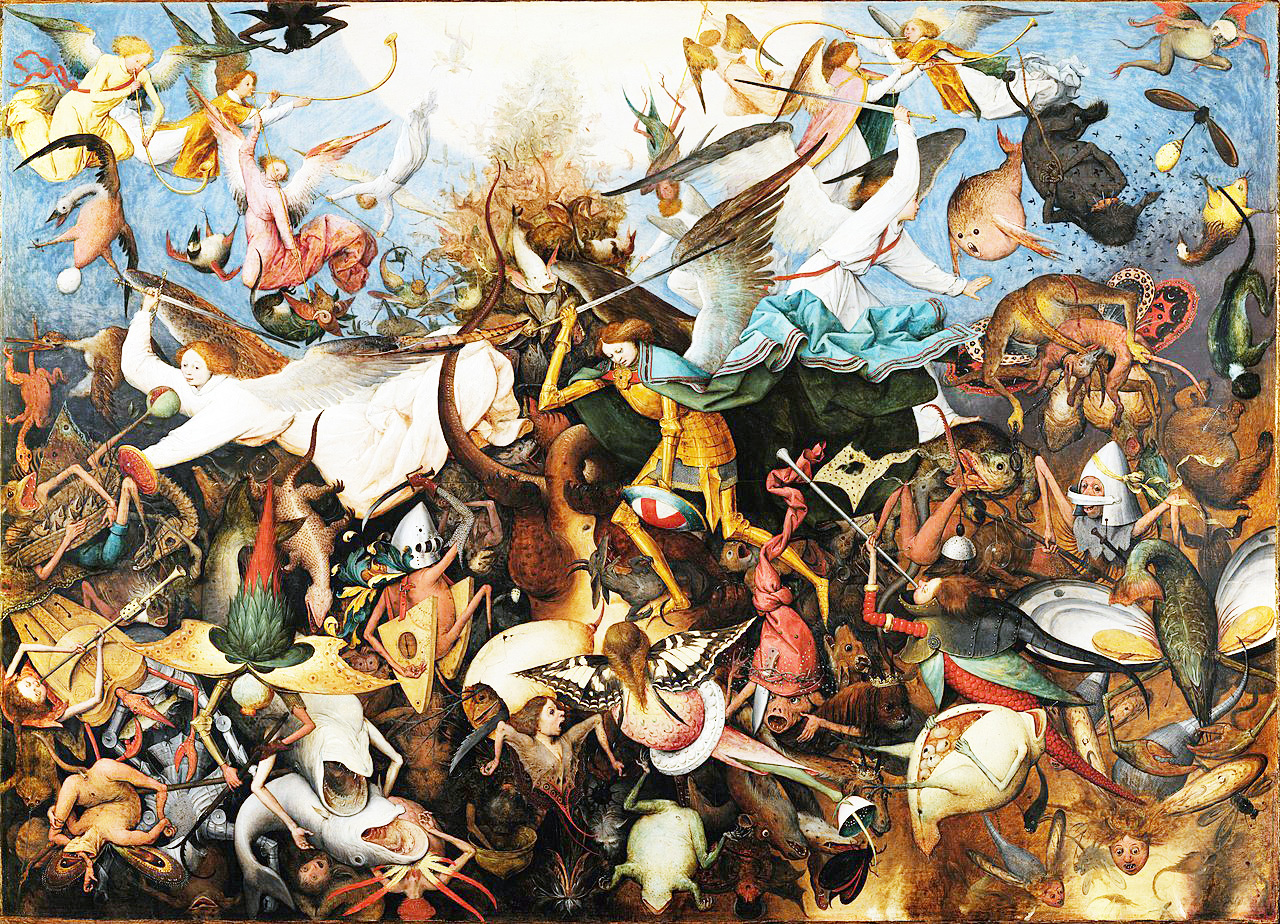
The Unseen Origins of War
No Other Institution From Satan Has Been More Destructive
We live in a world where wars and conflicts between people and nations are well-established institutions. Such conflicts have existed from the very beginning of mankind’s history, ever since Cain rose up against his brother Abel and killed him. Such conflicts have become so commonplace over the centuries that they are expected, like the Hatfields and McCoys feud in the 1880s and beyond, to the pre-flood conflicts wherein the thoughts of people were evil continually, through the wars of the ancient Babylonians, Assyrians, Persians, and Greeks, then to the Romans and on through the Middle Ages into the modern era in which peoples and nations worldwide have loosed the demon of death upon families and nations.
The Horrible Consequences
The terrible fallout from armed conflict worldwide is difficult to fathom. Death and injury of countless people is the obvious direct result, but the scourge goes far beyond this. The toll in human suffering is incalculable.
In an article by William Eckhardt, entitled “War-related deaths since 3,000 B.C.”
(Lentz Peace Research Laboratory of St. Louis, Missouri, U.S.A., Canadian Mennonite University, Winnipeg, Canada, 1990), Eckhardt extrapolated an author’s estimate of 29 million military battle deaths for international wars from 1816 to 1966. His estimate for all of history was 1.1 billion battle deaths. Another historian estimated 85 million civilian and military deaths for all wars from 1740 to 1974, and when this number was extrapolated for all of history the total number of people killed was an astonishing 2 billion!
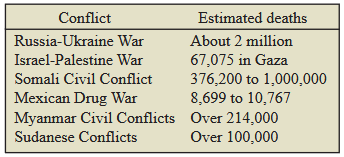 The number of wars between countries or various armed groups within nations is incalculable, and will not be enumerated here. One can examine various texts or websites which discuss armed conflicts to grasp some idea of how many thousands upon thousands of wars there have been. In 2025 alone there were at least six conflicts of note (www.ourworldindata.org; www.wikipedia.org). These numbers do not include the people injured during armed conflicts, or deaths and human suffering caused by indirect consequences such as famine, forced displacement, or disease.
According to the ACLED Conflict Index, (www.acleddata.com), which measures deadliness, danger to civilians, geographic diffusion, and the number of armed groups in countries:
“Conflict remained at a steady level over the past 12 months. ACLED records 204,605 conflict events from 1 December 2024 to 28 November 2025, compared to 208,219 events 12 months prior. These violent events resulted — conservatively — in over 240,000 deaths. The wars in Ukraine and Palestine continued to drive the level of violence, contributing over 40% of conflict events in the past 12 months. The civil wars in Myanmar and Sudan continued at high levels, and gang violence continued to drive conflict: Brazil, Ecuador, Haiti, and Mexico rank among the top 10 countries with the most severe violence in the world. Fighting in Syria continued despite the fall of Bashar al-Assad, and Nigeria saw no respite from its complex patchwork of regional conflicts. In Pakistan, worsening Islamist and separatist insurgencies in the country’s peripheries — exacerbated by at times explosive relations with its neighbors — resulted in further deterioration of an already fraught security environment.”
The Wide Impacts of War
1. Effects on populations. The Thirty Years War in Europe resulted in the population of the German states to be reduced by about 30%. Swedish armies alone likely destroyed up to 2,000 castles,18,000 villages, and 1,500 towns in Germany. During the Civil War in the United States, 8% of all Caucasian American males of age 13 to 50 died in battle, and of the 60 million European soldiers mobilized in World War I, 1.8 million were killed, 7 million were permanently disabled, and 15 million were seriously injured (www.wikipedia.org).
World War II causalities were astronomical: about 20 million soldiers killed along with 40 million civilians. The Soviet Union alone lost about 27 million people, and during the 872-day Siege of Leningrad, an estimated 1.2 million Russians died.
2. Effects on nations’ economies. According to one economist, “Negative unintended consequences occur either concurrently with the war or develop as residual effects afterwards, thereby impeding the economy over the longer term” (www.wikipedia.org). An estimate of an 11% annual reduction in the gross world product, about 9.49 trillion dollars, has been due to war. Wars cost plenty— the funding of soldiers, purchasing of armaments, deploying of equipment and fuel — strain a country’s resources.
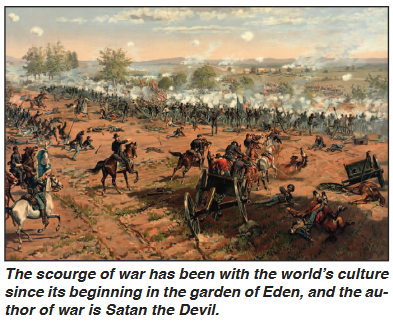 a. Destruction of infrastructure. Wars invariably result in the destruction of homes, businesses, schools, hospitals, bridges, power plants, roads, and most everything else. This devastation wreaks havoc upon the productive capacity of families, communities, and nations.
b. Disruption of the labor force. Not only are workman in many cases conscripted for the military, but loss of life, displacement of populations, along with the destruction of infrastructure conspire to lower productive output. Women oftentimes replace men in jobs that men normally occupy, disrupting family life.
3. Effects on society. In particular, health in the garden of Eden and survival are primary effects of war, but society is further affected in other ways.
a. Displacement. In many cases populations are forced to migrate during times of war. This movement disrupts family life and often leads to racial and religious conflicts, whether the destination is within their own country or a neighboring country. In 2015 about 65 million people in various countries were forced from their homes for fear of death or injury, especially from Somalia, Afghanistan, and Syria (www.wikipedia.org). Displaced people must rely on assistance from relief agencies for survival, or be content with low-paying work.
b. Psychological trama. Many psychological insults result from war, including the following:
-
- Anxiety and depression. These symptoms affect 40 to 50% of populations experiencing war.
- Trauma and PTSD. Soldiers often suffer from post-traumatic stress disorder (PTSD) after experiencing the trauma of battles. This trauma can lead to chronic mental health issues, such as alcoholism, arthritis, or heart issues which affect daily living and relationships. Rates of homelessness and suicide are much higher for combat-affected veterans.
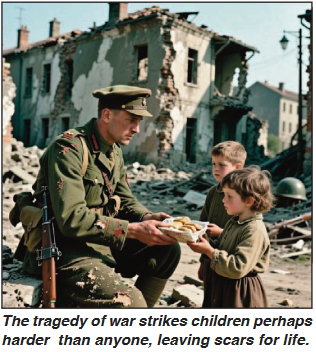
- Impact on children. Children in combat zones face high levels of stress that lead to insecurity, loneliness, and anxiety. These stresses can exhibit themselves as aggression, withdrawal, headaches, and stomachaches.
Nearly all of the civilian population is prone to develop trauma-related symptoms similar to what soldiers experience, even those having a strong social support network.
c. Disruptions in education. During war, teachers and students often suffer from death or displacement, which prevents the opening of schools. School buildings as well are subject to demolition by warring factions.
d. Gender effects. Women living in combat zones are apt to suffer greatly because their husbands may be called to fight, leaving them to support the children. The threat of abduction or rape, inability to procure resources and basic services for the home, and enemy attacks cause great trauma for most women.
 4. Environmental degradation. It is no secret that the shelling of towns and the countryside greatly disrupts natural ecosystems. In Ukraine, Russian troops planted mines across vast field areas to disrupt farming operations, and bomb craters pitted cropland in some areas. During the Vietnam War, Agent Orange was used to defoliate huge areas of tropical forest to expose enemy troops, but tens of thousands of Vietnamese were killed or maimed by it, and perhaps 500,000 birth defects have resulted. Depleted uranium in munitions used during the Persian Gulf War has caused many health problems for Iraqis and United States soldiers.
5. Cultural destruction. During war it is common for works of art and cultural heritage to be confiscated or destroyed. For example, during World War II Germany stole art from museums throughout Europe and stored these works at sites in Germany. This destruction is in part an effort to dishearten an opponent by destroying its cultural roots.
6. Political upheaval. The object of war is to conquer a perceived enemy through destruction or weakening of the opposing army so the opposition will either capitulate or cease to exist. Usually the defeated state has a change in leadership, or the land is absorbed into the victorious nation.
War Is Good? Some Say So!
The list of effects of war could be expanded even further, but let the afore-mentioned points suffice for now. In spite of these atrocities there are actually intellectuals who consider war to be good! One such professor is Ian Morris of Stanford University, an archaeologist and historian, who states so in his book, War! What Is It Good For? Conflict and the Progress of Civilization from Primates to Robots (Farrar, Straus, and Giroux, 2014):
“By fighting wars, people have created large, more organized societies that have reduced the risk that their members will die violently.”
This obvious conflict of sentiments, that killing and violence in war somehow reduces the risk of future violent death, Morris distills from the fact that in the Stone Age there was about a 20% chance of dying violently through war, as compared to a 1 to 2% chance of dying in battle through the 20th century, even in spite of Hitler, Hiroshima, Third World wars, and other conflagrations. He shows that up to 200 million people were killed in war during that century, while about 10 billion lives were lived.
Morris justifies his conclusion that war is good by observing that, through force, strong hierarchical governments have become entrenched as a result of conflicts, and that has led to men no longer fearing each other but rather fearing the authorities above them. Morris concludes that this top-down system has ironically been created not by reasoned discussion, but by war. He laments this conclusion, but asserts that humanity has found no other way. Such a view that war has somehow been of benefit to man kind is the type of reasoning that claims evil is good, excusing the wiles of Satan as being acceptable. A reviewer of Morris’ book stated:
“The march toward a more peaceful humanity from the Stone Age to the 20th century has not been steady but full of wild zigzags. In particular, Morris calls the anarchy of the Middle Ages the culmination of a millennium of ‘counterproductive wars that followed the breakdown of the ancient empires.’ Hard as it may be to believe, in general, imperialism has advanced humanity by making it safer and wealthier, and by aspiring to a universalism beyond tribe and ethnicity. Hitler’s attempt as imperialism burnt out after a few years because of his very extremism, whereas Rome, ancient Persia, Venice, Holland, France, Great Britain, and America have all fostered, more or less, human development through various kings of imperialist or imperial-like enterprises. And they have all done so in significant measure through war” (R. Kaplan, Why war is good, www.forbes.com).
God’s Nation and War
The desperate attempts of some intellectuals to claim that war is somehow good, despite the long list of horrible consequences of war already outlined, illustrates just how perverted the human mind can become when not motivated by the Creator. As Paul stated:
“Professing to be wise, they become fools …” (Romans 1:22).
“I will destroy the wisdom of the wise, and bring to nothing the understanding of the prudent” (I Corinthians 1:19, from Isaiah 29:14).
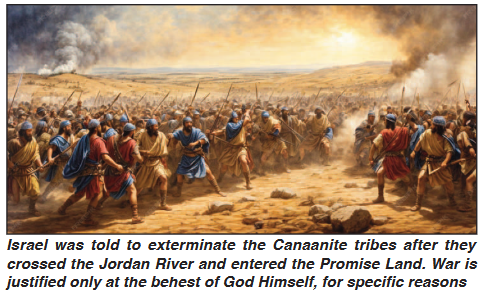 Our great God has a lot to say about war and fighting, which conflicts began when Cain slew Abel (Genesis 4:8). The sixth commandment forbids murder: “You shall not murder [ratsach, ‘to dash in pieces, i.e. kill (a human being)’], and this command extends to all types of killing, including those in wars between peoples and nations. The only allowance for killing with God’s approval is when He commanded the Israelites to destroy the Canaanite tribes who inhabitated the land the Israelites had been given. They were first told to drive out the inhabitants, but in several instances were told to exterminate them:
“Speak to the children of Israel, and say to them: ‘When you have crossed the Jorden into the land of Canaan, then you shall drive out all the inhabitants of the land from before you …. you shall dispossess the inhabitants of the land and dwell in it’” (Numbers 33:51-52).
“And they warred against the Midianites, just as the Lord commanded Moses, and they killed all the males …. ‘Now therefore, kill every male among the little ones, and kill every woman who has known a man intimately’” (Numbers 31:7, 17).
Sometimes entire populations of the Canaanite tribes were exterminated (Deuteronomy 13:15-17), and armies of invaders were killed, either by Israelite troops (Numbers 21:34-35), or by God’s direct intervention in destroying an entire enemy army (II Kings 19:35). The soldiers of Israel oftentimes suffered countless deaths in battles with the Philistines, Assyrians, and Babylonians, but these deaths were a result of Israel having forsaken their Creator and followed the pagan religions of the Canaanites or Egyptians. They desired a king to rule over them like the nations around them rather than the Eternal directly (I Samuel 8:6-22) … or He would have driven out the tribes before them by fear, confusion, and stinging insects or other agents from His natural arsenal:
“I will send My fear before you, I will cause confusion among all the people to whom you come, and will make all your enemies turn their backs to you. And I will send hornets [tsirah, ‘a wasp (as stinging)’] before you, which shall drive out the Hivite, the Canaanite, and the Hittite from before you. I will not drive them out from before you in one year, lest the land become desolate and the beasts of the field become too numerous for you. Little by little I will drive them out from before you, until you have increased, and you inherit the land” (Exodus 23:27-30).
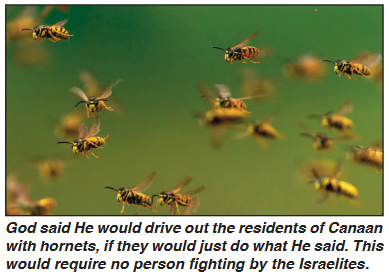 Through fear of Israel and continued attacks by hornets, the Canaanite tribes would leave the land God had given to Israel over many years, as they reproduced with large families and God’s abundant blessings of field and flock.
Almighty God never intended that the Israelites would have to kill their enemies; rather, He would do the killing. Yet, these hard-headed Israelites had within their hearts to emulate the Baals and Ashtoreths of the pagan Canaanite tribes. As Leviticus 26:14-43 and Deuteronomy 28:15-18 so eloquently state, the fruits of this path would be destruction to the nation.
James reiterated many centuries later the source of war in the human heart:
“Where do wars and fights come from among you! Do they not come from your desires for pleasure that war in your members? You lust and do not have. You murder and covet and cannot obtain. You fight and war. Yet you do not have because you do not ask” (James 4:1-2).
The Sinister Origins of War.
Let us look behind the scenes for the ultimate origins and motivations for war. We know that Satan is a murderer, for Jesus told the Pharisees, “You are of your father the devil, and the desires of your father you want to do. He was a murderer [anthropoktonos, ‘a man slayer’] from the beginning …” (John 8:44). That fact in itself should suffice to understand the origins of war and murder.
We also know that Satan rules throughout the nations of the world (Matthew 4:8-9; II Corinthians 4:4; Ephesians 2:2), and broadcasts his “frequency” of pride and carnality — the works of the flesh — far and wide (Galatians 5:19-21). How does he do this?
We are given strong hints of Satan’s methodology for fomenting wars and other mayhem across the world in several Scriptures. Let us examine them closely.
“Deuteronomy 32:8-9. “When the Most High gave the nations [goy, ‘Gentile nations’] their inheritance, when He divided the sons of men, He set the boundaries of the peoples according to the number of the sons of God [Elohim]. But the Lord’s portion is His people, Jacob His allotted inheritance” (Berean Standard Bible).
According to both the Septuagint and the Dead Sea Scrolls, this Scripture refers to the time when God divided the Gentile nations on earth among the sons of Elohim. The nations were sent away from Babel after God confused the languages of the various tribes whom Nimrod had captivated at the tower. They — the 70 nations of Genesis 10 — were scattered over the face of the earth (Genesis 10:32; 11:7-9). While many translations say “children of Israel” at the end of Deuteronomy 32:8, there are some translations that grasp the essence of these sons of God, who were given territorial jurisdiction over the nations:
“When the High God gave the nations their stake, gave them their place on Earth, He put each of the peoples within boundaries under the care of divine guardians. But GOD himself took charge of his people, took Jacob on as his personal concern” (The Message Translation).
“The Most High assigned nations their lands; he determined where peoples should live. He assigned to each nation a heavenly being” (Good News Translation).
“When the Most High gave the nations their inheritance, when he divided up humankind, he set the boundaries of the peoples, according to the number of the heavenly assembly” (NET Bible).
According to Michael Heiser, the “sons of God” translation of Deuteronomy 32:18 is correct, and does not require that this means Israel believed in polytheism. Both the Septuagint (LLX) and Dead Sea Scrolls (Qumran) show that “(1) the textual evidence favors the ‘sons of God’ reading, particularly when common misunderstandings of text-critical history and methodology utilized to favor the Masoretic Text are corrected; and (2) the concept of the divine council, common to ancient semitic religion, is contained in the Hebrew Bible and constitutes the theological backdrop for Deuteronomy 32:8-9. In light of the evidence,eiser. Deuteronomy 32:8 should read ‘sons of God,’ not ‘sons of Israel’” (M. Heiser, Deuteronomy 32:8 and the Sons of God, Biblioteca Sacra 158, January-March, 2001, 52-74, wwwdrmsh.com).
This Scripture in Deuteronomy implies that there was a son of Elohim parceled out to each nation … or more accurately to each tribe of people descended from the sons of Noah: Shem, Ham, and Japeth. Not all of these spirits are good (see Psalm 82 below), but their influence is felt through attitudes of leaders that these spirits influence. In some cases the leaders may be possessed by these spirits, such as Hitler when he attempted to rule over Europe, England, and all of the world. The Eternal prevented him from succeeding so that separate national spirits could continue to operate more independently.
Psalm 82:1-8. “God presides in the divine assembly; He renders judgment among the gods [Elohim]. How long will you judge unjustly and show partiality to the wicked? Defend the cause of the weak and fatherless; uphold the rights of the afflicted and oppressed. Rescue the weak and needy; save them from the hand of the wicked. They do not know or understand; they wander in the darkness; all the foundations of the earth are shaken. I have said, ‘You are gods [Elohim]; you are all sons of the Most High.’ But like mortals you will die, and like rulers you will fall. Arise, O God, judge the earth, for all the nations are Your inheritance” (Berean Standard Bible)
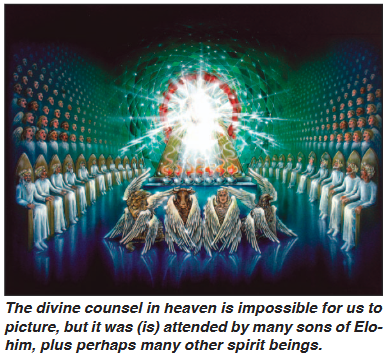 Here we see that the Elohim, sons of the Most High, are assigned to judge [shaphat, “pronounce sentence, for or against”] people and nations, but these particular spirits are negligent in carrying out God’s will to aid the poor, weak, and needy. They will eventually die — cease to exist — showing that spirit beings can perish. Perhaps these are among those who, along with Satan, will be cast into the lake of fire after the millennial reign of Christ and the saints (Revelation 20:10).
Daniel 10:13, 20-21. “However the prince [sar, ‘a head person, chief’] of the kingdom of Persia opposed me [likely Gabriel] for twenty-one days. Then Michael, one of the chief princes, came to help me, for I had been left there with the kings of Persia …. ‘Do you know why I have come to you?’ he said. ‘I must return at once to fight against the prince of Persia, and when I have gone forth, behold, the prince of Greece will come. But first I will tell you what is inscribed in the Book of Truth. Yet no one has the courage to support me against these, except Michael your prince’” (Berean Standard Bible).
Daniel 12:1. “At that time Michael, the great prince who stands watch over your people [Israel], will rise up” (Berean Standard Bible).
These verses in Daniel clearly show there are spirit “princes” who are heads over the various nations, here mentioned of Persia, Greece, and Israel. Some researchers have called these “territorial spirits,” in that they rule over certain geographical areas, or perhaps over specific families or nations … sometimes defined by a national boundary, but sometimes not. Perhaps one family of people is at times scattered in different places, for example white Anglo-Saxon Israelites scattered in the United States, Britain, Norway, Australia, and other countries.
These spirits have certain authority over the people of the territory in which they administrate. How they exert this authority has to do with the influence which they exert upon the attitudes and decision-making power of leaders. And, it is apparent that there is sometimes conflict among these sons of Elohim, which conflict likely is transmitted to the leaders of the territory which they oversee.
There is a “divine council” of spirit sons of Elohim mentioned also in Job 1:6 and 2:1 — where Satan was among the sons of God — and also in I Kings 22:19, where Micaiah revealed his vision of the Eternal sitting on His throne:
“… and all the host of heaven standing by, on His right hand and on His left. And the Lord said, ‘Who will persuade Ahab to go up, that he may fall at Ramoth-Gilead?’ So one spoke in this manner, and another spoke in that manner,’ Then a spirit came forward and stood before the Lord, and said, ‘I will persuade him’” (I Kings 22:19-21).
The Complex Forces of War
While people will point to differences between nations or populations due to religion, economy, race, and political views as the cause of war, we see there are malevolent forces behind the scenes in the spirit realm that can whip up leaders to initiate conflicts, leading to war. Daniel recorded how the prince of Persia withstood Gabriel for 21 days until Michael came to help him (Daniel 10:13), and then Gabriel indicated he had to “… fight with the prince of Persia; and when I have gone forth, indeed the prince of Greece will come” (Daniel 10:20).
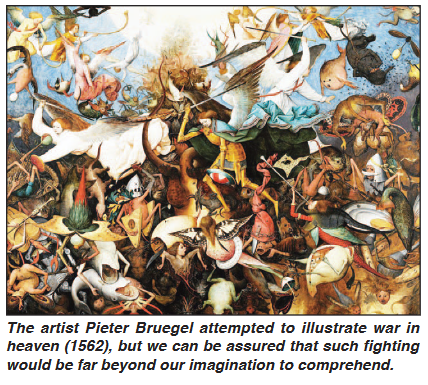 If spirit princes over the nations fight one another, how common it must be that their frequencies of influence must motivate their constituents to fight against one another as well. Such may be the case with the United States fighting against Iran … perhaps a modern-day battle between the prince of Persia — present-day Iran — and Michael, “… the great prince who stands watch over the sons of your people [Israel, present-day Anglo-Saxon America.]” (Daniel 12:1).
We must not forget the influence of Satan to promote merchandising through both sides of a conflict. After all, his first sin was that of merchandising — buying and selling — as we read in Ezekiel 28:15-16. For example, during World Wars I and II, Krupp Industries in Essen, Germany, supplied armaments and other resources to both the Allies and the Germanic forces (https://armingallsides.org), illustrating how war stimulates the economies of nations even though destruction of a nation’s infrastructure is carried out. In fact, that company has armed the militaries of Europe for 400 years!
The process of reconstruction after war’s devastation further stimulates buying and selling, so all aspects of conflict relate to the profiting of individuals and corporations that fund the supply of bullets, missiles, tanks, airplanes, drones, other equipment used to destroy people, cities, and countrysides. Satan’s system of buying and selling is greatly advanced by war.
The Future Sources of War
Prophecies are plain in laying out the source of future wars at the feet of Satan the Devil. Notice Revelation 12:7-8:
“And war broke out in heaven: Michael and his angels [aggelos, ‘a messenger’] fought with the dragon; and the dragon and his angels fought, but they did not prevail, nor was a place found for them in heaven any longer.”
This heavenly conflict then shifted to an earthly conflict, as the Devil and his angelic soldiers were cast to the earth (Revelation 12:9) and caused great mayhem … for he had great wrath and began to persecute the ecclesia. The Serpent “spewed water out of his mouth like a flood after the woman [the saints] …” to try and destroy them, but the earth “… opened its mouth and swallowed up the flood …” (Revelation 12:15-17).
Warfare of spirits against humans is real! Satan sought to destroy the elect — working through human agents he influences. The beast is pictured as having seven heads and ten horns which have ten crowns, or kingships. “The dragon gave him his power, his throne, and great authority” (Revelation 13:1-2), showing that the Devil directly influences and/or possesses these human agents that rule the nations, and sends out their military forces to fight. The beast has on the heads of the seven kings a “blasphemous name,” speaking blasphemous things [blasphemia, “vilification against God”] (Revelation 13:1, 5-6), which is what one would expect from such a vile creature as Satan.
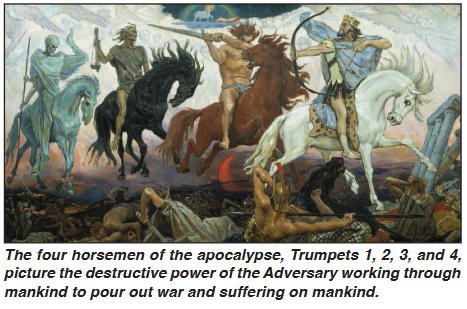 Elsewhere in the book of Revelation we see Satan fomenting wars and conflict:
- The first seal, a white horse with a bow and authority to conquer (Revelation 6:2)
- The second seal, a red horse, with a great sword to kill and remove peace (Revelation 6:4)
- The fourth seal, a pale horse to kill with the sword over a fourth of the earth (Revelation 6:8)
- More servants of God to be killed (Revelation 6:11)
- The fifth trumpet: Satan and his “locusts” ascend from the bottomless pit and torment mankind (Revelation 9:1-11)
- The sixth trumpet: countless people killed by a 200 million man army (Revelation 9:13-21)
- The beast ascends out of the bottomless pit and kills the two witnesses (Revelation 11:7)
- Those who will not worship the image of th beast are killed (Revelation 13:15)
- The ten horns (ten kings) give their power and authority to the beast and war against the saints (Revelation 17:12-14)
- Babylon — Satan’s worldwide system of government — is responsible for all deaths of prophets, saints, and all people killed in wars (Revelation 18:24)
The beast is the earthly power of man’s government and its military might — organized through Satan’s deception — that is on the earth at the end of the age. This beast and his armies are gathered in the vicinity of Jerusalem to confront the forces of Jesus and His heavenly army.
“And I saw the beast [therion, ‘a dangerous animal’; from thera, ‘a wild animal’], the kings of the earth, and their armies, gathered together to make war against Him who sat on the horse and against His army” (Revelation 19:19).
To the very end of the age this beast is bent upon war and killing of humankind made in the image of Elohim. The beast — who portrays Satan’s very image and character — even after being 1,000 years in the bottomless pit, is still intent on war and killing!
“Now when the thousand years have expired, Satan will be released from his prison and will go out to deceive the nations which are in the four corners of the earth, Gog and Magog, to gather them together to battle, whose number is as the sand of the sea” (Revelation 20:7-8).
Satan — the God of War
Satan the Adversary has one primary focus in his spirit life: replace Jesus Christ as future king over the earth, and destroy humankind that is destined to replace him as sons of God and brothers of Christ (Romans 8:29; I John 3:1). He wishes to regain the awesome position he had at the Father’s throne before he sinned (Ezekiel 28:12-15), and will do everything He can to achieve that end … even exterminating mankind in the process if necessary:
“And unless those days [of the great tribulation] were shortened, no flesh would be saved, but for the elect’s sake those days will be shortened” (Matthew 24:22).
He attempted, unsuccessfully, to tempt Jesus during the wilderness temptation to give Him authority over all the Kingdoms on earth (Matthew 4:8-9). Jesus knew His time to be the earth’s King was not yet, so He countered Satan’s offer with the Father’s words: “You shall worship the Lord your God, and Him only you shall serve” (Matthew 4:10).
The saints of the Most High have a mission on earth diametrically opposed to Satan’s mission: liberty of spirit versus oppression by evil.
“Now the Lord is the spirit; and where the spirit of the Lord is, there is liberty [eleutheria,
‘freedom’; from eleutheros, ‘unrestrained (to go at pleasure), i.e. (as a citizen) not a slave (whether freedom or manumitted), or exempt from obligation or liability’] (II Corinthians 3:17).
This freedom in living is the most exhilarating spiritual gift imaginable! The liberty extends from the spirit of the Eternal living within oneself, which yields love, joy, peace, longsuffering, kindness, goodness, faithfulness, gentleness, and self-control (Galatians 5:22-23). These fruits are contrasted to the fruits of the flesh which include adultery, fornication, uncleanness, lewdness, idolatry, sorcery, hatred, contentions, jealousies, outbursts of wrath, selfish ambitions, dissentions, heresies, envy, murders, drunkenness, and revelries (Galatians 5:19-21).
 It is obvious that these works of the flesh are what lead to wars. They are the attitudes that Satan infects people with to serve him, not serve the Creator who designed mankind after His own image to serve Him and his fellow man, and reap abundant life (John 10:10). It is the way of life that Adam and Eve experienced in the Garden of Eden — joyous and life-enriching — not the way of war and suffering that Cain embraced when he slew his brother.
The origins of war begin in the spirit realm, Satan motivating national leaders through the many princes of nations to serve selfish interests. Those motivations are rooted in fruits of the flesh. What appears to be conflicts between nations due to religion, race, or imperial ambitions are actually hostilities originating in the spirit world among Satan’s minions, transmitted to human vessels resonating with their frequencies.
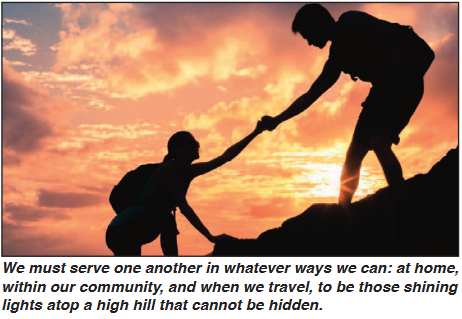 We as God’s people must be clothed with His spiritual gifts, and express the love of Him and our neighbors as Paul eloquently stated in Roman 12:9-15:
- Let love be without hypocrisy.
- Abhor evil.
- Cling to what is good.
- Be kindly affectionate to one another with brotherly love.
- In honor give preference to one another.
- Do not lag in diligence.
- Be fervent in spirit, serving the Creator.
- Rejoice in hope.
- Be patient in tribulation.
- Continue steadfast in prayer.
- Distribute to the needs of the saints.
- Be hospitable.
- Bless those who persecute you.
- Rejoice with those who rejoice, and weep with those who weep.
Remember the words of Proverbs 15:1:
“A soft answer turns away wrath, but a harsh word stirs up anger.”
These are the ways that avoid war and killing of one’s enemy. These are the ways that Jesus so eloquently told us to emulate:
“For who is greater, he who sits at the table, or he who serves? Is it not he who sits at the table? Yet I am among you as the One who serves” (Luke 22:27).
And, as Paul said, we are to do good to our enemies:
“Behold, do not avenge yourselves, but rather give place to wrath; for it is witten, ‘Vengeance is mine, I will repay,’ says the Lord. Therefore, ‘If your enemy is hungry, feed him; if he is thirsty, give him drink; for in so doing you will heap coals of fire on his head’” (Romans 12:19-20).
We as God’s people are poised to inherit a kingdom on earth that will completely put down the works of Satan the Devil. This great evil spirit will be locked within the bottomless pit for 1,000 years (Revelation 20:1-3), which will terminate war because the cause of wars will be gone. Instead, the earth will rejoice as in the garden of Eden, and peace will reign on earth!
“He shall judge between many people, and rebuke strong nations afar off; they shall beat their swords into plowshares, and their spears into pruning hooks; nation shall not lift up sword against nation, neither shall they learn war any more” (Micah 4:3).
It is Satan’s nature to generate war and conflict, but it must not be so among us, for we are God’s people. We have the spirit of peace, forgiveness, joy, and lawful living. The Creator made mankind to be this way. Let us so live in the loving abundance of His presence!